Comments on ELECTRO HOMEOPATHY RESEARCH
Comments by the Great Physicians
The most perfect system of medicine is one that is Electro-Homoeopathy, because these are non poisonous and do not create drug disease or leaves any bad effects, so it is the true remedy which always gives the extra something which the body needs.
A.J.L. Gliddon
Electro-Homoeopathy is perfected system of medicine, by the discovery of new therapeutic agents (which I call electroids) acting on the blood and giving to the organism the power necessary to cast off the morbid element which injure it.
R.M. Theobald
The magical and marvelous operation of these remedies is a perpetual surprise even to those who have long used them. The simplicity of their administration brings the healing art within reach of all that care to devote to it a moderate amount of thought, study and observation.
Thedor Krauss
An account of matteis marvelous medicines having some valuable results and some fruits of my own experience.
E. Acworth
The new materia medica, tried now in many localities of the north, south and west of Europe, always produce the same effects and every where gains new adherents. A certain numbers of physicians, struck by these results, have decided to give it a trial, and the action of these specifics is always certain, we may rest assured that in time without any other recommendation then there admirable efficacy matteis remedies will over come all opposition and obtain the favour which they merit.
S Berard
The action of the Electro Homoeopathy Medicine Febrifugo, I succeeded in a very short time in subduing the most obstinate fevers which no means have previously conquering.
Prof. Pascucci
I have always had the best results from the use of Count Mattei's remedies.
Dr S. Kennedy

|
Free book electrohomeopathy by Electro Homeopathy Research Council of India- HRCI .pdf Size : 3861.816 Kb Type : pdf |
Modern usage
A symposium took place in Bologna in 2008 to mark the 200th anniversary of the birth of Cesare Mattei, with attendees from India, Pakistan, Germany, UK, and the USA. Electrohomeopathy is practised predominantly in India and Pakistan (RAJYA SABHA Parliamentary Bulletin- The Recognition of Electro Homoeopathy System of Medicine Bill, 2015 by E. M. Sudarsana Natchiappan, M. P), but there are also a number of electrohomeopathy organizations and institutions worldwide
ELECTROPATHY/ELECTRO- HOMEOPATHY
Electro Homoeopathy
This term is derived from three words-
ELECTRO comes from the electro bio-energy content extracted from plants and the way that energy is extracted and made into remedies. The force of electro bio-energy connects itself to any disturbance within the body and expels it from the system. It thereby restores the organic tissues and nervous system to their proper balanced state of health. Electro also indicates Electrolytes of the Body.
HOMOEO refers to the equilibrium or balance between the blood and lymphatic systems and works towards “Homoeostasis” which is the correct physical and chemical consistency of the body’s cells. This ensures that each and every cell interrelates as it should so that the body functions at its best.
PATHY basically means a system of treatment. In short, Electro Homeopathy is the system of natural medicines, made exclusively from plant extracts, by which a healthy balance is achieved and maintained throughout the whole body.
According to electro-homeopathy – Electro means the activity or the source of stasis. This activity is found in plants and their strength has chemical power to quickly fill the imbalance of the body chemical.
As we cannot see the electricity power directly, we can see it working by a simple experiment. If the power is switched on the bulb or a tube light starts glowing. In the same way, plants also have electricity that cannot be seen directly. The plant develops in the soil with water, air and light. It grows seeds, fruits, flowers, vegetables with full of different chemicals.
The plants also have electrons. They have power of absorbtion. They absorb the sunlight, water and air through their power and through their power of electrons they convert the light, air, soil and water into chemical substances. In the chemicals there are living enzymes. The enzymes are soul of plants. The enzymes soul is extracted with their original activity which they have.
There is a vital relation between the plants and human being. The imbalance of man’s immunity is filled with plant chemicals via enzymes. The enzymes are the core of life.
The body is complex structure, connected with cell to tissue, tissue to make organ and organ to make the body, like this the leaves, stem, root makes structure of plants. And according to law of nature all the living organism derives the energy from sun light, air, water and soil. The source of stasis secreted in plant is Electro.
Enzymes have some specific biological activity. Some break down proteins, other’s act on fats and carbohydrates. Chemically the enzymes are proteins and because of this special procedures must be used to prevent them from losing their precious biological activity.
Each enzyme is a special protein adopted on the particular chemical process. Different digestive enzymes changes different food stuffs into liquid form that can pass into the blood and travel around the body. Other enzymes change digestive food so that it releases energy and still other uses of energy to build food in substances. Enzymes also convert any poison in the body into safe substance.
The source of activity in plants is called Electro. Through this activation the cells tissues, organs, glands and hormones are working and producing the chemical to give energy to body. The secret power of activity is called OD force or Radioactivity. The human body is controlled by the energy, as their requirement, to be balance with chemical enzymes is Homoeostasis.
Homoeo – means similar, Stasis – means stay in proper balance.
As we all know what it feels like to be alive, but life itself is difficult to define. It is usually summed up by all characteristics that living thing share. These characteristics include respiration, which involves the release of energy by chemical process, as well as nutrition and excretion. Living things also show the growth and development, because they get bigger and become more complex as they get older, and sensitivity, which means they can respond to the world around them, most important living things can produce a new life. It is very important for life to live and die and succeeds to one generation to another, through the chemicals basis.
The plant chemicals have power to secrete the medicinal property in them. The presence of vital energy by the OD force (odd force) in the nature kingdom – has to store the medicinal properties with the different qualities with the process of extracting and to balance the body as requirement to cure the disease. The balance of the body chemical with the plants chemical through enzymes they pass in the body to purify the lymph and blood is Electro.
There is an acronym for Electro.
Electro is Energy – Energy is Power – Power is activity
Electro is relating to combination form of
E-L-E-C-T-R-O
where each word has its significant meaning :-
E – energy
L – lymph and blood
E – enzymes
C – combination
T – treatment
R – remedy (medicine)
O – organization of the whole body
ENERGY
The most common form of energy that man has used over the ages and still continues to use is the energy stored in the muscles of the body. He obtains the energy from food that he eats and age wise or fall sick, our ability to do physical work decreases.
It is our common observation that rubbing our hands makes them warm. We say that the energy of our hand has been converted into heat energy. The energy that raises the power to do the work is force. All the world’s action and movements are caused by energy. Light, heat, electricity are all forms of energy. Human energy comes from food.
LYMPH AND BLOOD
Lymph and blood are the two important factors of human organ. Lymph is a colorless fluid containing white blood cells, drained from tissues and conveyed through the body in the lymphatic vessels.
Blood is circulated by the heart, carrying oxygen and digested food to all parts of the body. The human body is kept up by the continual process of decomposition and re composition, as our system undergo waste by constant vital work and this waste is replaced by new material, derived from the pure blood and lymph and this is the most essential part of physiological process. Thus the health depends upon the normal condition of the blood and lymph and disease is produced from their abnormal state, chemically health is the chemical equilibrium between the waste and supply and the disease is the disturbance of equilibrium of lymph and blood. The cause of disease is vitiation of lymph and blood.
ENZYMES
Enzymes are the soul of plants. Enzymes are extracted with their original activity which they have. Plants have the power of absorbtion to absorb from nature. They have capacity to convert the mixture of light, air, water in the form of medicinal property in chemical base, that are living enzymes. They have chemical substances that speed up the changes.
Enzymes are the switch of the sources of increasing the boost level of immunity and stimulation in our body. Our body is made up of trillions of microscopic cells. A healthy living. Our cells depend upon enzymes. Enzymes are complex protein which helps us to digest the food and absorb it via the blood stream. Without enzymes there would be no life.
If the presence of a substance changes the rate of chemical reaction but its chemical form remains unchanged in the end of reaction, then it is called Catalysis, and the substances is called Catalyst, so the enzymes are an organic catalyst usually a protein, which control the cells chemical reaction. The reason being they do not undergo any change.
COMBINATION
The process of combining various medical plants according to their respective quality and required quantities to form new compound altogether with different properties is called combination.
TREATMENT
The manner of applying remedies to a particular disease in subject to the system is the treatment given to the patient by a doctor.
REMEDY
Removing or relieving disease or bad condition after a diagnosis is called its Remedy.
“just as a plant grows from nature’s creation, so the remedy grows in the hands of a physician.”
ORGANIZATION
Good health and fit body gives an indication of perfect circulation of lymph and blood throughout the entire system. This is called a healthy organization of the body. Homoeo (similarity) The purification of lymph and blood – physiologically, the tendency of an organism to maintain internal equilibrium, as of temperature and fluid content, by the regulation of its bodily process. Pathy – the system of medicine
“electropathy is a homoeostasis herbal healer with natural enzymes.”
Electro Homeopathy has four fundamental laws
- LAW OF POLARITY
- CONSTITUTION & TEMPERAMENT
- LAW OF DOSOLOGY
- SELECTION OF REMEDY
BASIC PRINCIPLES OF ELECTROPATHY: COMPLEXA – COMPLEXIS – CURANTUR
The principal holds that the body is of complex structure and only complex remedies for the complex disease will prove worthy. Body constituent of nature have united to frame up the body. There are different organs introducing the main unit of each cell together to form a tissue – and tissue to form an organ, several organs unite together from a human body so it is a complex process. Therefore the disease which invokes will be complex. A complex remedy will cover up all the areas, which have been effected. The principal of this medical science is “complexa – complexis – curantur” which means that complex disease is cured through complex medicine. The aims of the principal being that our body is a complex build up. So only complex mixture remedy for complex disease will prove worthy.
CURANTUR
The drug treatment that gives relief or recovery from disease or to correct a harmful or troublesome situation is a process or method of Curantur. To restore the health with soundness and normality by preparing the medicine through the process of combination brings the recovery, is curantur.
TEMPERAMENTS
The person’s nature makes up, disposition, and lifestyle is temperament.
DR.COUNT MATTEI had the materialistic and vitalistic idea, so he classified the human rays into different temperaments having affinity towards illness. He classified the temperaments into five categories:-
- Sanguine temperament – Having a healthy red color, ruddy, a sanguine complexion, easily gets nervous and tendency to hemorrhage, inflammation, sinusitis, and migraine and mostly suffer from brain disease and may collapse with hypotension or hypertension or stinging in the ears.
Vital energetic circulation of blood, well nourished organs.
- Lymphatic temperament – Looking fair, fatty, flabby, with general tendency, skin eruption, cold, cough, stomach disease, suppuration of glands, leucorrhoea and piles.
Climatic aggravation, unsuitable foggy climate, lack of R.B.C.s and excess of W.B.C.s soft hair and the person has a tendency to bad food habits and fast life.
Lacking energy and pale looking. A lymphatic appearance or temperament was formerly thought to be too having too much lymph in the blood.
- Mixed temperament – This type of patient suffer both the characteristics of lymphatic and sanguine constitution. The mixed constitution generally the disease of glandular tissue, glandular organs cellular tissue are found, because of dysfunction of the lymph and blood and insufficient excretion of waste matter of the metabolism, and consequently degeneration of tissue, suppuration of gland, tumors are formed.
- Nervous temperament – This type of patient are easily distinguished for irritation in all negative condition. Any fear may bring paralysis and secondary amenorrhea may produce nervous shock. Insufficient nourishment to the nerves for example in ‘neurasthenia’ condition is found.
- Bilious temperament – Suffering from or caused by some trouble with the bile or the liver leading to jaundice, loose motions, green diarrhea, cirrhosis of liver, obstruction of billiary duct, bitter taste of tongue, grey hair, are found in billous temperament.
LAW OF POLARITY
The treatment is also based on law of polarity. Our body also has positive and negative points. The positive and negative points if kept in steady state would help in removing disease. There is also positive and negative charges in the body. The right portion of the body is positive and left is negative. The attraction of electro-homeopathy medicine is also based on the law of polarity. With the purification of blood and lymph the imbalance of positive and negative disease, force is brought in equilibrium, thus the disease will be cured completely.
OD FORCE
Every human being, animal and natural kingdom, all objects of nature are related to each other by the force called od force. The creation is controlled by supreme power and also behind that the supreme power is controlled by entire creation like sun, moon, stars, and planets.
Every creature depends upon others in this creation, for e.g. man and animal depend upon plant and nature. The man gets food and medicine from plants and animal. And plants get food from nature like soil, light, water and air and the power of gravitation.
They get the energy to live and function properly. The human body is also controlling by this energy and the energy gives life to human being by living healthy. When the energy is withdrawn, death occurs. When the man or any animal falls ill he gets necessary energy in the form of medicine from the plant which is stored in them. Our blood and lymph get force for the proper function from this energy of OD force. OD force when taken out in the form of spageric essence which is used to cure the disease, and vitiation of lymph and blood is no more.
The OD force is activator of physiological activities. OD force is known as ‘Force of life’. It has the secret power to create the activity.
SPAGERIC ESSENCE-COHOBATION-FERMENTATION
In Electropathy all medicines are made from spageric essence of the plants. Cohobation is the method of extracting the spageric essence of the plants, which is the vital energy of plants that store in them and has a powerful capacity to cure the disease.
The leaves, flowers, fruits, buds, roots, branches, bulbs are normally collected at the time of maturity, or collected in spring or autumn when they are in blooming stage, or when they have medicinal properties in full vigour.
Cohobation is a process of fermentation in which the living energies of the plants are kept stored. By making incisions the sap may also be obtained when it falls. This is dissolved in distilled water by maceration method.
“EH MEDICINES MEANS SOME SPAGERIC ESSENCES BROUGHT TOGETHER TO MAKE A DRUG WITH DESIGNATION. SPAGERIC ESSENCE IS COLLECTED THROUGH COHOBATION PROCESS OF FERMENTATION OF THE FRESH PLANTS.”
Founder of Electro Homoeopathy
Italian Noble, COUNT CEASER MATTEI founded true Electro Homoeopathy in the year 1865 in Bologna, Italy. Being strongly influenced by the philosopher Paulo Costa, Count Mattei was motivated to devote his time and wealth to the service of humanity. He built on the works of Indian metallurgists and Ayurvedic /Siddha practitioners; he widely read Indian literature about medicinal plants. He was impressed with a true secret that plants and human body have same temperature. So he made medicines without disturbing the normal temperature i.e. 37° C. He experimented on Paracelsus and BAL root methods also. But he totally focused on preparing remedies extracted exclusively from plants as he realized that plants are best means of treating Diseases and Disorders. He called these remedies electro homoeopathic medicines on own his experiments of 30 years which show in his plants extract as vegetable electricity.
Later on this system was further developed by Mattei adherent Theodore Krauss who have given the manufacturing method known as Krauss method (also mentioned in German Pharmacopoeia HAB) for making electro homeopathic remedies.
Electro Homeopathic Remedies —How Do They Work?
They work on the principle that diseased organisms are far more sensitive than healthy organisms. Much like the area of skin around a cut or a graze is more sore and tender than its surrounding areas. A remedy is never given to just remove the symptoms from the body, but to work totally on the disease and remove its cause. It therefore works on the body as a whole.
Each remedy is derived from the active enzymes of several plants. When you take this complex remedy it completely covers and controls the body. It will then move through the body via the blood and lymphatic systems and target only those areas that requires it. Once the diseased part is sufficiently saturated with the remedy, it stops absorbing it. When all the parts of the body have been healed and a healthy balance restored, the medicine itself is no longer absorbed. Therefore, there are absolutely no risks of over-dosing, side effects or drug dependency.
Electro Homoeopathic remedies purify the lymph and blood systems and can find and destroy the gravest of disorders. They can also help prevent disease by keeping the body pure and giving it a healthy balance.
Principle of Electro Homoeopathy
In sick person, the body fluids, lymph & blood become polluted and all the parts become abnormal state, which is why the disease develops in the body. Electro Homoeopathy is system of dynamic form of healing force extracted from the plants. It preserves and controls the organism Lymph and Blood, consisting of atoms, molecules, cell tissues, organs etc, by purifying them and returning them back to the normal state. The sick person recovers speedily and completely.
Why was the name given Electro Homoeopathy?
The name Electro Homoeopathy comes from the Electro content extracted from the plants, and the way this energy is extracted and made into the remedies. Electro Homoeopathy is a name given by the founder COUNT CEASER MATTEI, on the basis that those remedies are class of energy conforming to the law of similar and they possess a power and promptness and speed of action of the remedy which allows them to be compared to electricity. Electro is not related to the electricity current and not using any type of electric machine in the treatments.
Theodore Krauss was the disciple of Count Mattei. Mattei made only 38 remedies in his life time but Krauss added more 22 remedies in his life time. After death of Count Mattei the progress and development was stopped in First World War, so therefore Krauss took charge and established the pharmacy of Electro Homeopathy in Germany which is why this pathy also known as spageric method of Krauss.
The proving of remedies
Electro Homoeopathic remedies work on the principle that diseased organisms are far more sensitive than healthy organisms and change the condition of the bodily fluids. A remedy should not be given to remove the symptoms of the body but to work on the cause of the disease.
What is the difference between Electro Homoeopathy & other therapies?
Electro Homoeopathy is a system of medicine that draws all of its remedies from non-poisonous plants. It does not use sources from the mineral or animal kingdom. The remedies work with nature and help the healing force in the shape of Electro element.
Who can use Electro Homeopathic remedies?
Electro Homoeopathy can be used by anyone of any age group who suffers from acute to chronic illnesses, for example, depression, arthritis, migraine, ulcers and any kind of Disease and Disorder.
What are the side effects?
These remedies are all extracted from non-poisonous plants and do not create drug addiction or side effects. All remedies use the physical properties and not the chemical ones and are therefore ideal to combat the human body disorders without any side effects.
How do Electro Homeopathic remedies work?
The manner of preparing these compound remedies is the method of “cohobation”. This method uses plant extracts in the higher energies (vital force). This is a very potent invisible force, abstract in the natural form and transforms every constitution of the living being as an ‘Od Force’ (vital force). Each remedy is derived from the active enzymes of several plants. When the complex remedy is administered to the patient it completely covers and controls the body. The remedy will then move through the body acting on the parts that require it. As soon as the diseased part is sufficiently saturated with the remedy, it stops to absorb it. When all the parts of the body have been healed, the medicine itself is no longer absorbed.
What does the treatment involve?
This will depend on the individual & their personal health fitness. The holistic approach to illness needs to be given time & many ailments will not disappear overnight. Therefore a course of treatments is recommended to get the best result. Electro Homoeopathy treatment is always based on the Law of Temperament. The patient may be lymphatic, sanguine, mixed, bilious or of a nervous temperament. The person belonging to a specific temperament will show symptoms based on that constitution. In order to learn the constitution of the patient, a full background into their history any inherited family health matters is required. A remedy is then given accordingly.
What to expect when, visiting a practitioner?
The patient will be asked questions relating to their medical history and perhaps that of their immediate family. Lifestyle questions, such as stress levels, diet; exercise regimes, and sleep patterns will be asked to ensure that a holistic approach is taken. Their own expectations of the treatment and what they hope the therapy will achieve will also be discussed. It is necessary for the practitioner to know that the patient comes under which temperament then the treatment can be assessed. The disease or condition they are displaying will also indicate what medicines should be taken. The patient will need to take the medicines, which come in the form of pill and liquid. You will be asked to attend another consultation when your prescription may change.
ABOUT SPAGYRIC THERAPY
ACHARYA NAGARJUNA an Indian metallurgist and alchemist, born at Fort Daihak near Somnath in Gujarat in 931. He wrote the very first treatise RASARATNAKARA that deals with alchemical preparations.
Spagyric medicine is ancient natural medicine that has undergone 500 years of trial, research and practice. Paracelsus the famous Swiss physician, Philosopher and alchemist is regarded as the founder of spagyric , but it was almost forgotten until the 19th century.
Dated from three times of Paracelsus, the terms spagyric and spagyrism are derived from the Greek verbs “Span” (to seperate) and “Ageirein” (to unify). They designate the art of creating medications of enhanced efficacy by performing the two fundamental alchemical operations. the valuable portions are first separated from those which are impure processed and subsequently reunited to yield an improved medicinal form (HELMSTADTER 1990). The source materials of spagyric medicines are exclusively from botanical origin. Depending upon the manufacturing process, differentiation is made among spagyrism according to Krauss.
Around the turn of the last century the Italian herbalist Count Cesare Mattei (1809-1896) rediscovered the lost spagyric art and founded the system known as electro homoeopathy in Italy. Mattei borrowed from Paracelsus the process of preparing the vegetable substances by means of a more or less complicated mode of fermentation, called cohobation, and also the final combination of the number of ingredients with similar or supplementary effects to form a complex medicinal unity. Mattei has kept the formulation secretly until the age of 78 for some unrecorded reasons and he gave all his work to his adopted son in laws Mario Ventrouli Mattei in 1887. After Mattei death in 1896 one of his disciple Theodor Krauss (1864-1924) has established his system in more advanced way. When the real supply of these remedies stopped in 1917 due to World war 1, Krauss reinvented the method in more scientific process known as Krauss method. Today the pharmaceutical company ISO, GmbH Germany is continuing his tradition via JSO Komplex heilwisen. First of all, these preparations enjoy success and worldwide appreciation because of their carefully chosen ingredient. Based on his key research with the founder of system COUNT MATTEI, Krauss added a few more combination remedies to the system, characterized by their broad therapeutic spectrum, they are highly acclaimed spinal cord of the system by experts from all over the world specially Germany since 1920.
SPAGYRIC THERAPY ACCORDING TO KRAUSS
The central pillar exists in spagyrism according to Krauss: phytotherapy, within the present context, phytotherapy is to be understood as the traditional art of healing with plants. The spagyric medications are administered in either their 4th or 10th decimal potency. The clinical propertise of the active medicinal substances within each preparation help determine the selection of the appropriate medication. In the Krauss’ school of spagyric therapy, pathological processes are not viewed simply as isolated instances of dysfunction in individual organs or within the mind. Therefore, the objective is to detect and treat the course of disease in the interactions with all the body processes.
In order to adequately cover the multi-level interconnections of an illness, this type of therapy employs complex medications consisting of a combination of numerous single-ingredient spagyric remedies. Selection of the appropriate spagyric agents to be included within a complex is based on the physiological and anatomical relationships existing among individual body functions, organs, and organ groups. The single-ingredient agents are combined into such a manner to influence a group of organs closely associated with one another in either a physiological or anatomic-histological manner. Contained within one Electro homeopathic medication are single-ingredient agents with similar fields of actions as well as those that influence the pathological condition from a variety of aspects.
The constituents are combined to target the illness synergistically while mutually supplementing their effects. Thus they selectively direct their effects within the diseased organism at multiple levels, each in correspondence with its individual rang of action, thereby collectively creating stimulation of the body’s intrinsic defensive and regenerative powers (Bruch 1939, Krauss 1989).
In the book “The Hidden Roots: A History of Homeopathy in Northern, Central and Eastern Europe” by Prof. Dr. Robert Jütte, Director of the Institute of History of Medicine Foundation Robert Bosch in Germany is written that Dr. Alexander Rosendorff (1871 – 1963) became “acquainted with Electrohomeopathy” when he met CEASER MATTEI. The sign which he had installed in 1920 outside his practice in Tallinn, Waldstraße, however, said: ‘Homeopath’.
In the book “The essay on history of Homeopathy in Latvia” Marina Afanasieva, Medical Dept., Vice-President of LMHI of Latvia, published by the “Liga Medicorum Homoeopathica Internationalis,” France has written a significant part on Mr. Feliks Lukin ( 1875-1934) that he learned Elettromeopatia from Dr.Rosendorf in Tallinn (Estonia) and practiced in France but with the name Homeopathy.
In Farmacopia Omeopatica Germany, published by the federal government, the formulas are described as delll’Elettromeopatia formulas Omeopatiche.
Bärbel Tschech (Dip. biologist) in her article : A Discussion of Complex Homeopathic Remedies ,translation by Siegfried Letzel, published in Hpathy Ezine – July, 2007 Zimpel and Mattei have been described as homeopaths.
DESCRIPTION OF THE REMEDIES
- SCROFOLOSO remedies, act on the scrofolous disorders and the metabolism.
- LYMPHATICOS remedies act on both systems of lymph, and blood especially the white blood corpuscles or Lymphocytes.
- ANGIOITICOS remedies, which act on the blood vessels the arteries and the veins, and the circulatory system.
- CANCEROSO remedies, act on cellular construction and the chronic degeneration of Lymph.
- FEBRIFUGO remedies, act on the fevers and all types of intermittent diseases, as well as disorders of the spleen and liver.
- VERMIFUGO remedies act on the intestines, but also on the other parts of our organism, and then also destroy all worms.
- PETTORALE remedies, act on the respiratory system and bronchial tubes.
- VENEREO remedies have a general constitutional effect.
ELECTRICITIES OR FLUIDS
- RED ELECTRICITY is an arterial and nerve stimulant. This increases the vitality of the body.
- BLUE ELECTRICITY has tonic effects on the circulatory system, when used in a diluted form it calms the organs which is over stimulated.
- GREEN ELECTRICITY promotes venous system and helps with chronic diseases and arthritic conditions.
- YELLOW ELECTRICITY relaxes muscular or nervous tension, diminishing organic function and excitement.
- WHITE ELECTRICITY exerts a gentle, calming influence over the nervous system.
- APP water for skin keeps the skin fresh and smooth as cosmetic effect.
Advantages of Electro Homeopathic Remedies –
- These remedies are all extracted from plants, having energetic properties. They produce energy in the body; its action is gentle and sometimes instantaneous, but more generally gradual of such a nature that the results can only be perceived after some minutes.
- They correct the deficiency or excess to natural proportions and recover the disease speedily, gently, completely and permanently.
- They do not simply cure the particular disease for which they are prescribed, but at the same time good to the constitution of the patients who uses them.
- The true remedy gives the extra something, which the body needs. They are non-poisonous and do not create drug disease or leave any bad effects on the body.
- It is not extremely facilitated and simplified in this way, in the most complicated illness as well, but also it is more economical of what is so important in the present period of necessity.
- It is especially adapted for universal use as household remedies. No mother dread her child’s life has been endangered because she has taken some of the medicines in error, nor need she ever be haunted by the fear, so often experienced by those who give bromides and other hurtful drugs that may turn out to be worse than the disease.
Electropathy medicines purify the blood and lymph and gives amazing result on the human body in many cases which are said to be incurable in other branches of medicine.
History of Electropathy
ABOUT THE HISTORY
PARACELSUS (1493 – 1541)
Paracelsus was one of the most important Renaissance naturalists. Paracelsus full name is: Theophrastus Bombastus Von Hohenheim 1493 - 1541 . He put forward the view that disease resulted from external enviormental forces. He also believed that plants and natural substances held the key to healing and embraced the ‘like can cure like’ priniciple. One of his ideas, known as the Doctrine of signatures, was that the apperance of a plant, or the substances it contained, gave an idea of the disorders it could treat. As a youth Paracelsus worked in the nearby mines as an analyst. This gave him the background for his future work in chemistry and alchemy that, doubtless, laid the foundations of his later remarkable discoveries in the field of homoeopathy and Electro-homoeopathy.
Count Cesare Mattei (1809-1896)
Electro-Homoeopathy is the name given to a new system of medicine discovered by a famous Italian Count Cesare Mattei in the later part of the 1800’s. Count Mattei, the founder of Electro-Homoeopathy, was born on the 11th January in the year of 1809 in Bologna City in Italy. He belongs to one of the noblest families of learned town of Bologna.
After having studied natural science, he gave himself up to anatomy, physiology and pathology. Then more exclusively to chemistry and botany, after long and patients research following a method of his own, he discovered how to extract from certain plants the active principles which, alone or combine, form the agent in the new materia medica. Numerous and prolonged experiments upon the animal economy, experiments made first of all upon the dogs, have demonstrated the curative power of his remedies upon the organism, and at the same time have proved that they can never produce the slightest morbid alteration either in the organs or their functions.
He believed in the, famous Paracelsus who introduced law of similar. Thus convinced simultaneously of their immense utility and of their perfectly innocuous character, the count has applied to them with all confidence to all of the human beings. Further, in order to observe closely in numerable cases of disease, and the better to study the effect of these remedies, he held in his mention at Bologna, for more than ten years, public and private consultations in the presence of physician and surgeons who had attached themselves to him the purpose of being present at the sitting. It may be added of high person ages of all nations, physicians and even large medical bodies. But undoubtedly the German founder of Homoeopathy Hahnemann (1755-1843) and his doctrine have non the less influenced Mattei’s mind in his patients researches, leading principle trying to investigate the immediate effects of remedies and bring them into practical service according to the familiar rule. On the other hand, he borrowed from Paracelsus the process of preparing the vegetable substances by means of a more or less complicated mode of fermentation, called “cohobation”, and also the final combination of a number of ingredients with similar or supplementary effect to form a complex medicinal unity.
Mattei had written his first book in 1874 in Italian language, which was then published in other languages. He has applied himself in his lifetime to the discovery of Materia Medica capable of modifying; not only the manifestation or symptoms of disease, but also their principle, or to speak better their first cause. It is by means of a theory the simple, with curative agents which he called Electricity in the remedies (Electro-Homoeopathy), so elementary that everyone may cure himself and his medicine is certainly the medicine of the future.
He died on 3rd of April 1896 at the magnificent castle of La Rochetta, situated in the heart of the Apennines. If there are but few honest hearts in this world, there is still enough remaining to bless his memory. During mattei life time when the Count Mattei aged in 1887 he handed over all his work to his adopted son Mario Venturoli Mattei. Later on after the First world War Mattei remedies were stoped to export from Italy, then V. Mattei made the agreement with the German Pharmist and Theodore Karuss to sell mattei remedies via Engel Apotheker Regensburg in Germany. This System later on become more popular & recognized than ever by his disciple Theodore Krauss.
Theodore Krauss (1864-1924)
The German practitioner Theodore Krauss (1864-1924) made a notable contribution to electro homeopathy medicine and JSO Spagyric medicine which is based on his method. At the age of 56 and after his key experiences with pharmacist Johannes Sonntag established” JSO Komplex Heilweise”, an exhaustive body of information.
Count Mattei in the early year of 1880 set up Consortium for electro Homoeopathy for the sale and promotion of his remedies inRegensburg. In the year 1883 the Consortium was transferred to the Engel Pharmacy in Regensburg for selling the remedies. The Consortium remained responsible for publication of the literature and assistance for these remedies to the 7000 members of the electro homeopathic practitioner. About two year later, Theodore Krauss joined the Consortiums for electro Homoeopathy and remained there in contact with Count Mattei till the year 1890. But after the death of Mattei in 1896, the Theodore Krauss took over the Consortiums for electro Homoeopathy; later on he expanded the system.
In the First World War the supplies from Italy were missing between the years 1914 to 1918. The first original medicines under the license were after-produced in the scientific direction of Krauss and Dr. med. Johannes in the same direction as the Mattei method and his system. The system later established by Theodore Krauss and became known as Electro complex Homoeopathy, which developed up to today and is known as JSO Komplex Heilweise (JKH).
After Theodore Krauss death his work was continuously moving forward and his first book published back in 1920 on electro homeopathy has published its 14 edition till today in Germany. Following that, Spagyric had an official place in Europe and in the German Pharmacopoeia.
Source: the JSO Komplex heilweise
Carl Friedrich Zimpel (1800-1878)
In the nineteenth century, the German physician Carl Friedrich Zimpel, M.D., Ph.D. (1800-1878), began a new production of spagyric medicaments. This widely travelled and learned man had originally been an engineer. He devoted himself late in life to the study of medicine and acquired a doctorate in philosophy and medicine. He was awarded the Prussian gold medal for art and science and was an honorary member of the Mineralogical Society of theUniversity of Jena. In 1849, he was established himself in London as a homeopathic physician. Zimpel devoted himself intensively to the study of the works of Paracelsus and Glauber. At the age of 70 and after his key experiences with Count Cesare Mattei (1809-1896), he published book on the subject. Gradually, he developed an important production, known today as Zimpel method which is also descried in German Pharmacopoeia [HAB] a high level, internationally known manufacturing Pharmacopoeia, whose products are today available in many countries of the world. In the meantime, many classical texts have been reprinted, in connection with which the attitude of the publishers vacillates strongly. Available, for instance, are the works of Paracelsus, Basilius Valentines, Glauber, Van Helmont, Andreas Libavius, and others.
facts of electropathy
Important Facts About Electropathy There are some important fact about the electro- homoeopathy, which shows that it is a system of medicine with their own philosophy and fundamental principles based on scientific way. Therefore elctro- homoeopathy remedies are different from other therapies. These remedies is not related to: Any uses of electrical devices. did not use any kind of electric equipment in their treatment. Electro word not related to electricity current elctro- homoeopathy is differing from original homoeopathy in some aspects. Electropathic medicines are complex in nature based on organopathy as well as in the scientific process. not based on symptoms like homoeopathy. Electropathy is not a new science it had been introduced in 19th century and its remedies are based on very old philosophy of Paracelsus round about 16 century.
historical books of electropathy
HISTORICAL BOOKS
- AMMON, D. Zwölfjähriges Herz-Leiden durch Electro-Homöopathie geheilt. Berlin, ca., 1900.
- Banerjee H.D. Lectures on Electro-homoeopathy 1909
- Bonqueval, J. G. de. Electro-Homoeopathische Heil-Methode. Neue Wissenschaf (1893).
- Berard M. Electro-Homoeopathic specifics1875
- Clerc, G. A. Count Mattei Electro-Homoeopathic remedies 1894
- Combe George The Constitution of Man 1893
- Gliddon A.J.L 3rd edition Stepping Stones to Electro-Homoeopathy 1893
- Hewier, Cesare Mattei, Elektrohomoopathische Arzneiwissenschaft 1888
- HEWSER, Dr. Med. Lehrbuch der Elektro-Homöopathie 1899
- Krauss Theodor Die grundgelete der-Elektro homoopathie
- Krauss Theodor Die grundgelete der-Elektrohomoopathie1921
- Kennedy S Dr. The Cancer Controversy Mattei vs the Knife 1891
- Kumar Vinod Notes from Studies in Dr Paul’s advanced studies in Electro homoeopathy 1998
- Mattei Count Cesare the Principles of Electro-Homoeopathy a new science 1880
- Mattei Le Comte Cesar Medicine Electro-Homeopathique ou nouvelle therapeutique experimentale par 1883
- Mattei Cesare Die ElectroHomoopathie Brunodpatze either neuen wissenschatt 1898
- Mattei Cesare Die brundgelete der-Elektro+homoopathie 1925
- Mattei Cesare Elektro-Homoeopattie grundsatze einer neuer wissenschaft vom verfasser einzig autorisirte deutsche ausgabe 1881
- Mattei Comte Cesar Vademekum der Elektro-Homoopathie 1874
- Mattei Comte Cesar Principles De L’Electro-Homoeopathie science nouvelle
- Mattei Cesare Electro-Homoopathische-Heil-Methods 1879
- Mattei Comte Cesar Les Remedies Electro-Homeopathiques 1925
- Moler J.V. Elektro Homoopathildhe Arznemittellehre 1895
- Peter. MOSER F. Elektro-Homoopathische Arzeneimittellehre. Charakteristik der Elektro-homoopathischen Heilmittel.
- Reichenbach Karl Von translated and introduction by F.D.O. Byrne The Odic Force Letters on Od and magnetism 1926
- Regard Dr Quelques mots sun les Specifiques du Comte Mattei 1872
- Rorande Nagra Fragor Elektro-Homoopatie upptackt af grefve Casar Mattei 1886
- Saksena Baldeo Prasad A material medica of Electro-Homoeopathy 1914
- Sandars W.Collett and Jules Bue Class-book of Comparative Idioms English part 1897
- Theobald R.M. Electro-Homoeopathic medicine a new medical system 1888
- Wallace J, Robertson, The Constitution of Man
- Zimples Dr.Med. Spagyrisches Heilverfahren 1937
electro-homeopathy medicine
Electro-Homoeopathic Medicines
-
There are only 114 plants are used to make the total 60 remedies.
-
These plants are divided into Nine Combinations Groups.
-
Nineth Group are further CLASSIFIED under Five Heads.
9 Groups of the medicines
- Angioiticos remedies, which act on the blood vessels the arteries and the veins, and the circulatory system.
- Canceroso remedies, act on cellular construction and the chronic degeneration of Lymph.
- Febrifugo remedies, act on the fevers and all types of intermittent diseases, as well as disorders of the spleen and liver.
- Vermifugo remedies act on the intestines, but also on the other parts of our organism, and then also destroy all worms.
- Linfatico remedies act on both systems of lymph, and blood especially the white corpuscles.
- Pettorale remedies, act on the respiratory system and bronchial tubes.
- Venereo remedies have a general constitutional effect.
- Scrofoloso remedies, act on the scrofulous disorders and the metabolism.
NAME OF THE ELECTROPATHY REMEDIES
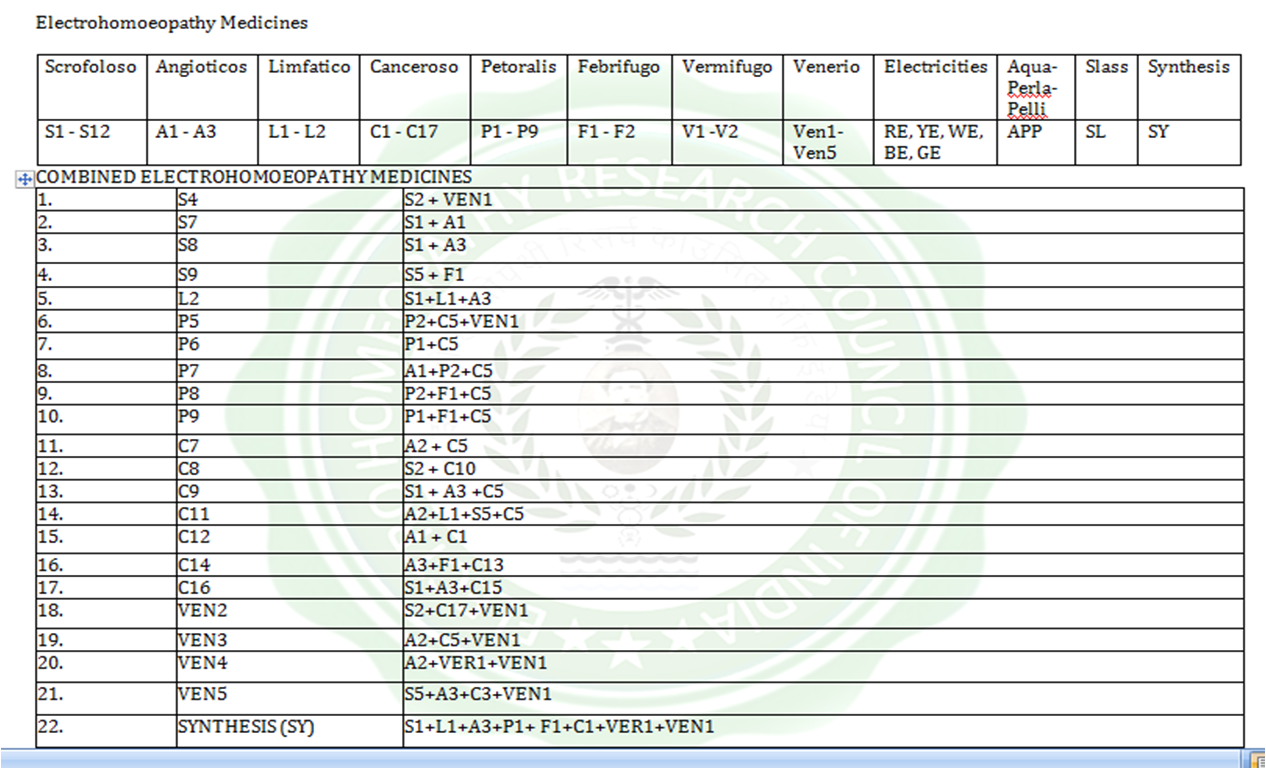
English NameGerman NameInitialTOTALAngioiticosAdermittelA3CancerosoGewebemittelC17FebrifugosFieber - und NervemittelF2LinfaticoLymphmittelL2PectoralBrusmittelP9ScrofolosoStoffwechselmittelS12VermifugoDarmmittelVer2VeneriosKonstitutionsmittelVen5Slass Slass1Synthesis SY1ElectralsFluide Blue ElectralCapsellaBE1Green ElectralPopulusGE1Red ElectralRhododendernRE1Yellow ElectralSambucusYE1White ElectralViscum albumWE1Aqua Perlla Perli APP1
Electrals
- Red Electral - is an arterial and nerve stimulant. This increases the vitality of the body.
- Blue Electral - has tonic effects on the circulatory system, when used in a diluted forms it calms the organs which is over stimulanted.
- Green Electral - promotes venous system and helps with chronic diseases and arthritic conditions.
- Yellow Electral - relaxes muscular or nervous tension, diminishing organic function and excitement.
- White Electral - exerts a gentle, calming influence over the nervous system.
Special
Slass - is uses as laxative
Synthesis - is use a tonic suited for a state of general degeneration of the humours and tissues, as wekll as after treatment of serious illness.
Aqua Perlla Perli – is a skin water for keeps the skin fresh & smooth
These fluids maybe employed, according to disease, pure or diluted, internally or externally
Quite similar is the effect of the ointments, likewise denominated after plants, to which regular; besides other remedies the fluid corresponding to their name is added. There is, for instance, an Ointment, Blue Ointment a green ointment and so one. The fluids as well as the Ointments represent a very valuable part of remedies, and, being employed in the right way, have often lead to immediate success.
Remedies
REMEDIES
-
INDICATION
Series of the Blood Remedies
Influencing the blood and its motorial apparatus, cardiac and vascular system
ANGIOTICO 1 OR
Arterial system, heart, being low potenced excitant, increasing cardiac power, being high potenced against active hyperaemia, hypertonia
ANGIOTICOS 2 OR A2
Being high potenced against passive hyperaemia owing to interruptions in the venous circulations, vericose veins disposition for bleeding of the nose
ANGIOTICOS 3 OR A3
Blood especially red blood corpuscles, remedy for convalescence and formation of blood, deficiency of blood and general debility, especially of children. Chlorosis after loss of blood and the illness consummating the body, marasmus, nervous affection caused by under nourishment or anaemia and neurasthenia.
The Series of Tissue Remedies
It acts especially influences the cellular structure, for instance metabolism remedy influences the action, the tissues remedy the structure of the organs, their composition, decomposition and recomposition.
CANCEROSO 1 OR C1
The entire complex of glands, general remedies of the cellular tissues of an extremely vast effect, which influences the decomposition, the wrong composition of tissue cells. Chronic catarrh of the nose and throat. Hormonal disturbances and Irregular menstrual cycle.
CANCEROSO 2 OR C2
Bladder, and infection of the urinary passages, cystitis, haemorrhoids. Jelly-like and gelatinous sediments in tissues and joints. Also act on liver and gall bladder.
CANCEROSO 3 OR C3
Remedy for skin, intestines and Glands. Inflammatory and allergic dermatitis and psoriasis. Colitis ulcer, with other remedy S3 and L2. Chronic diarrhoea.
CANCEROSO 4 OR C4
Bone-tissue, joints rickets, injuries of the bone, gouty sediments in joints and muscles, breaking and splintering of nails, fall and loss of hair. Teeth and their insufficient growth. Caries of teeth, inflammation and catarrhs.
CANCEROSO 5 OR C5
Skin, glands, especially liver, venous system, rheumatic indisposition’s of muscles and joints, are corresponding with S5. Inflammations, Acute eczema, goitre, and prostate gland.
CANCEROSO 6 OR C6
remedy for the kidney and Urinary system. its central action on the kidneys and influencing mineral metabolism, arteriosclerosis, and gout. Renal anaemia and cataract with other remedy S12.
CANCEROSO 7 OR C7
disease of the venous system and degeneration in the veins, varicose veins, haemorrhoids and boils. Also acts on the Cramps, chronic inflammations and insufficiency of right side of the heart.
CANCEROSO 8OR C8
remedy for the Glands and mucous membranes of the gastric and intestinal system, especially liver and gall. Pancreatic gland, large intestine and great gut. Portal vein, vegetation nervous system. Also acts on chronic constipation, gall stone, diabetes mellitus.
CANCEROSO 9 OR C9
Serious derangements of nourishment’s and metabolism. Stomach, lymph organs, glands, liver and decomposition of blood connected with them. Stomach abscess and Nourishment accompanying in diabetes.
CANCEROSO 10 OR C10
Nervous troubles of gastric intestinal canal, large and small intestine, great nut, liver, gall bladder. Chronic constipation, warts, cyst, and swelling, Cholecystitis.
CANCEROSO 11 OR C11
Venous system, liver, gall, skin, and muscles. It is of extensive effects owing to its combination, for internal as well as external use in all states of decomposition, diatheses, particularly in uric diathesis, gout, and rheumatism and stone. Arthritis and rheumatoid arthritis
CANCEROSO 12 OR C12
Acute, inflammatory diseases of the mucous membrane and glands. Congestion, carbuncle in the first stage.
CANCEROSO 13 OR C13
Remedy for the pharynx, tonsils, laryngitis, catarrhs and gullet. Diphtheria, tonsillitis, sinusitis and inflammation of the nose.
CANCEROSO 14 OR C14
Remedy for the pharynx, acutely inflammatory, feverish derangement of the pharynx, catarrh of the upper bronchial ways.
CANCEROSO 15 OR C15
Gastric remedy, special gastric remedy, peritoneum and predisposition to rupture elastic tissues of the abdominal muscles.
CANCEROSO 16 OR C16
Remedy for the gastric problems, serious gastric diseases, and general interruptions of assimilation and decompositions of blood owing to such gastric indispositions.
CANCEROSO 17 OR C17
Contractor of the bladder, retention of urine, bubble in the bladder and enuresis nocturnal.
The Series of the Fever or Nerve Remedies
It’s a far vaster effect than its name suggests and chiefly influences the whole, unconsciously working nervous apparatus, the sympathetic nerve centres and nerve braids, brain and spinal marrow. It chiefly affects nervous troubles in the circulation of the blood, in the peripheral vascular system as well as nervous derangement’s of the heart, besides interruptions in the regulation of temperature, production of sweat, the functions of our liver and of the other organs connected with the regulation of the metabolism and power balance.
FEBRIFUGO 1 OR F1
The whole vegetative nervous apparatus, hypo tension, nervous derangements of heart, production of sweat, diluted doses in fevers, palpitations and nervous conditions.
FEBRIFUGO 2 OR F2
Peripheral nerves, chiefly for external use. Neuralgia’s, itching of the skin, sensitiveness, spasms, and spleen.
The Series of the Intestinal Remedies
Different diseases are often connected with the appearances of the certain parasites means foreign substances in the human being for instance of different sorts of intestinal worms or of monocular microscopically microbes. These ones essentially develop and breed because of an interrupted metabolism and an indisposition’s of the various tissues; The intestinal remedies stimulate the disinfecting made by ones own body, influence the intestines by purging and secreting, regulate the stools, in an especially favourable way with chronicle constipation through stimulating the intestinal glands and peristaltic. They are acting against worms by cutting the essential condition that is the morbidly transformed contents of the intestines means fermentation, purification’s from these parasites, above all maw worms and spring or pin worms are susceptible. Moreover these remedies arouse the means of defence of the organism, thus are bactericide and, therefore, qualified as intermediate remedies against all acute and chronicle diseases all the more since they have similar qualities as the fever remedies as stimulants for the nerves.
VERMIFUGO 1 OR VERM 1
All the parasites and microbes especially in the intestines, infection in the acute stage of intestinal region, diarrhoea. Infectious diseases, especially in the acute stage.
VERMIFUGO 2 OR VERM 2
Chronicle disposition for being attacked by Microbes. Infections in the chronic stages.
The Series of the Constitutional Remedies
It is an old fact founded on experience that by the constant effects of heavy damages, especially by serious diseases or by the abuse of alcoholic and narcotic poisons the inherited constitution of a man may degenerate so that the worst constitutional defects are transmitted to his descendants. The constitution remedy is the chiefly remedy to fight such hereditary constitutional defects. It is one of the most universal, remedies generally to ameliorate our constitution, and therefore, extremely valuable also for supporting all the specific remedies. Combined with them, it may by use against all chronicle diseases, especially constitutional ones.
VENEREO 1 OR VEN1
Remedy calculated generally to better constitution, metabolism, circulation of blood and lymph, chronic dermatitis and rashes. Bladder catarrh.
VENEREO 2 OR VEN2
Bladder and its mucous membrane, Chronicle catarrh of the bladder and bubble in the kidney.
VENEREO 3 OR VEN3
Remedy for the Glands and mucous membrane and skin. Chronic inflammatory skin diseases i.e Colitis ulcers, intestine polyp.
VENEREO 4 OR VEN4
chronic Skin diseases, stomatitis and abscess
VENEREO 5 OR VEN5
chronic eczema, rashes, psoriasis and neuro dermatitis.
The Series of the Lymph Remedies
Its influences the lymphatic ways and the organs being charged to prepare, purify and move the lymph and the entire liquid between the tissues.
LINFATICO 1 OR L1
The whole lymphatic system, states of decomposition of the lymph and blood, nervous debility spasms, glands and their tumours and inflammations. Chronic eruptions, hernias and mastitis
LINFATICO 2 or L2
Metabolism, lymph and blood, which are influencing the whole current of humours. chronics dermatitis, loss of appetite and general weakness.
The Series of Pettorale Remedies
It acts influencing the respiratory organs, stands between the series of blood remedies and that of tissue remedies.
PETTORALE 1 OR P1
Generally influencing the respiratory organs, windpipe, bronchial ways, cough, catarrh, and shortness of breath caused by obstruction with phlegm.
PETTORALE 2 OR P2
Catarrh indispositions of the respiratory organs, especially requiring the elimination of viscous mucous, marvellous results on the chest TB.
PETTORALE 3 OR P3
Wind pipe and its ramifications, catarrhs, cough, inflammation of wind pipe, whooping cough, bronchial asthma, chiefly remedy for females and children’s.
PETTORALE 4 OR P4
Nerves of the respiratory tracks, convulsive cough, nervous asthma, shortness of breath, asthma of the advanced age, best remedy for the old peoples.
PETTORALE 5 OR P5
Constitutional indisposition’s of the respiratory organs, actions on the lungs, pulmonary cells, bronchia, it more effect hereditary tuberculosis disposition.
PETTORALE 6 OR P6
Bronchia’s, pulmonary vesicles, Chronicle, mild bronchial catarrhs.
PETTORALE 7 OR P7
Acute, intensive forms of inflammations of the bronchial ways accompanied by violent hectic fever or bloody sputum.
PETTORALE 8 OR P8
Chronicle bronchial catarrh with slight raising of temperature viscous expectoration.
PETTORALE 9 OR P9
Feverish, acute forms of the bronchial catarrhs with convulsive cough and vomiting of phlegm
The Series of the Metabolism- Remedies
Primarily takes effect on the organs working for the exterior assimilation as well as gastric intestinal canal with glandular appendage, then secondarily on those organs and tissues being usefully combined with them, which works for the interior assimilation, and last, but not least universally or constitutionally through the influence of these important organic functions on the whole organisms, that’s why it is called universal remedy.
SCROFOLOSO 1 OR S1
Universal remedy for the entire metabolism, stomach, intestines with glandular appendage, secreting, stimulating metabolism and appetite, if regularly used it influences in an extra ordinary favourable way the whole constitution. Strengthening, cleaning, decontaminating and purifying the lymph
SCROFOLOSO 2 OR S2
Bladder, catarrhs of kidney, liver and gall bladder, gastric glands, intestinal mucous membranes with constipation, piles, gall stones.Heartburn as far as this appears as a result of a disturbed gall secretion.
SCROFOLOSO 3 OR S3
Skin dermatoid and hypodermic cellular tissue, eruptions, chronic herpes, dry and discharging ones, the sensible nervous system nervousness. Intestinal mucous membrane, colitis, eczema, neuro dermatitis.
SCROFOLOSO 4 OR S4
Catarrh diseases of the kidneys and main act over the bladder and urinary tract infections. Chronic inflammatory intestine diseases and gall stone.
SCROFOLOSO 5 OR S5
Liver, formation of the bile, secreting uric acid, skin and hypodermic cellular tissue with acute eruptions, eczema and Production of the gall secretion. Joint Rheumatism
SCROFOLOSO 6 OR S6
Remedy for stones in the kidneys, secreting remedy, arteriosclerosis, and dropsy. Improve the kidney function, nephritis. Diuretic, deposit in the joints, gout.
SCROFOLOSO 7 OR S7
Acute, inflammatory diseases of the assimilation apparatus, stomach gland mucous membranes.
SCROFOLOSO 8 OR S8
Assimilation, formation of blood, green sickness, and anaemia, with bad nourishment or in convalescence.
SCROFOLOSO 9 OR S9
Nervous troubles of the gastric and intestinal canal, functional debility of the liver, insufficient secretion of the bile. Colitis ulcers crohn’s diseases.Diseases of the spleen, especially spleen swelling feverish skin diseases.
SCROFOLOSO 10 OR S10
It is act on the nervous gastric indigestion and acute diseases, symptoms of colds, infection migraine. Infection and cold illness, hyper acidity, Cramps and colic and heart burns. Food allergy.
SCROFOLOSO 11 OR S11
Pharynx and gastric nerves, nausea, retching, vomiting. As well as nausea and vomiting of pregnant women, similar indisposition’s at railway, in the travelling and sea trips, vomiting with sick headache or migraine.
SCROFOLOSO 12 OR S12
Special remedy for eyes, for external and internal use, catarrhs, inflammations of the conjunctiva.
SLASS
This is laxative, nervine and anti scrofulous remedy, its act on the intestinal mucous membranes, intestinal nerves and intestinal glands.
The Series of Electrals
The Fluids are remedies prepared to influence the balance of nervous pluses. Our brain is the centre of nervous inpluses. It contains millions of ganglion cells like stations for producing and in nerve power. But also directing important organs outside our brain, especially those situated in and next our organs of sense and our entrails, in our heart and intestines, in the big digestive glands there are numerous ganglions cells of such as kind, often combined in vast complexes to ganglions. The outer stations are also used for producing and directing nerve power. All these power and switching stations are connected to one another and to the big centres in our brain through conducting, the so called nerve fibres, which often combined like cables, run in thinner or thicker cords through all the parts of our body.
BLUE ELECTRAL
Innervations of the arterial system through internal and external use, If doses undiluted, it is stimulant and boost the system as a tonic, but if diluted it is sedative. All sorts of inner or external bleeding. Regulation of the heart activity and the circulation (undiluted: stimulating / diluted: calming). Undiluted dose act on Low blood pressure diluted dose act on high blood pressure. Bleeding piles and acute inflammations.
GREEN ELECTRAL
The venous system, It is employed against chronically ulcerating wounds, such as fistula, boils of the varicose veins, haemorrhoids, besides against ulcerating angina and gumboils to rinse one’s mouth, against abscess, Chronicle rheumatic pains and arteriosclerosis processes. Chronic inflammations of the skin and mucous membranes i.e. the intestine mucous membranes, catarrh, Cystitis. Non bleeding piles, chronic wet eczema and gall bladder and urinary bladder, Stomatitis, Gingivitis. Arthritis and gout.
WHITE ELECTRAL
Exhaustion condition, neurosis, pains, insomnia in diluted doses. Neuralgia (external at forehead, neck and on painful places). Headache, migraine, menstruation troubles, chest pain during the period (external as an ointment). Neurasthenia with increased excitability.
RED ELECTRAL
Stimulant. Arousing nervous activity accelerating vital processes, therefore the remedy for phlegmatic persons. To be used against troubles of inner secretion, diseases of the joints and all the states of debility and paralisation, particularly in order to prevent paralisation to defective nervous activity. It serves for local stimulation and sympathises with the metabolism remedies.
YELLOW ELECTRAL
Sedative, diminishing organic functions, to be employed against all conditions of excitement and irritation. For internal and external use, above all against spasms of the gastric intestinal canal and of the gall bladder. Its effects correspond to the febrifugo and vermifugo remedies. States of intense psychic excitement. Muscular convulsions, tickling cough and the like. Corresponding to the frequent change between excitement and relaxing at all nervous and psychic indisposition doses of YE and RE are of a very favourable effect if alternatively used.
AQUA PERLA PERLLI OR APP
It influences skin nerves and cutaneous glands, the tropic derangements of the skin. It is employed not only as a remedy in the diseases, but it is also suitable admixed as a cosmetic, for the care of the skin, to the water for washing, to the soap and ointments, besides, combined with Euphrasia or S12, it has a beneficial effects on the eyes.
advantage
Advantages of Electropathy Remedies These remedies are all extracted from plants, having energetic properties. They produce energy in the body; its action is gentle and sometimes instantaneous, but more generally gradual of such a nature that the results can only be perceived after some minutes. They correct the deficiency or excess to natural proportions and recover the disease speedily, gently, completely and permanently. They do not simply cure the particular disease for which they are prescribed, but at the same time good to the constitution of the patients who uses them. The true remedy gives the extra something, which the body needs. They are non-poisonous and do not create drug disease or leave any bad effects on the body It is not extremely facilitated and simplified in this way, in the most complicated illness as well, but also it is more economical of what is so important in the present period of necessity. It is especially adapted for universal use as household remedies. No mother dread her child’s life has been endangered because she has taken some of the medicines in error, nor need she ever be haunted by the fear, so often experienced by those who give bromides and other hurtful drugs that may turn out to be worse than the disease. Electro-Homoeopathy Makes Its Way By Itself
plants of electropathy
1. ACHILLEA MILLIFOLIUM (Herb) Yarrow
2. ACONITE NAPILLUS (Herb)
Monkhood
3. ADIANTUM CAPILLUS VENERIS (Herb)
Maidenhair Fern
4. AESCULUS HIPPOCASTANUM (Tree)
Horse Chestnut
5. AGARICUS MUSCARIUS (Fungi)
ToadStool
6. AILANTHUS GLANDULOSA (Tree)
Chinese Sumach
7. ALLIUM CEPA (Herb)
Red Onion
8. ALLIUM SATIVUM (Herb)
Garlic
9. ALOES CAPANCES (Herb)
Socotine Aloes
10. ALTHEA OFFICINALIS (Shrub)
Marshmallow 1
1. ANTHEMIS NOBILIS (Shrub)
Roman Chamomilla
12. ARNICA MONTANA (Herb)
Leopard’s Bane
13. ARTEMISIA ABROTANUM (Shrub)
Southern Wood
14. ARTEMISIA CINA (Shrub)
Worm Seed
15. ATROPA BELLADONNA (Herb)
Deadly Nightshade
16. AVENA SATIVA (Herb)
Oat
17. BERBERIS VULGARIS (Shrub)
Barberry or fawn lily
18. BETULA ALBA (Tree)
Birch tree
19. CANNABIS SATIVA (Shrub)
Hemp
20. CAPSELLA BURSA PASTORIS (Herb)
Shepherd’s Purse
21. CARDUS BENEDICTUS (Herb)
Blessed Thistle
22. CAULOPHYLLUM THALICTROIDES (Herb)
Cohosh, Blue
23. CETRARIA ISLANDICA (lichen)
Iceland moss
24. CHELIDONIUM MAJUS (Herb)
Celandine
25. CHENOPODIUM ANTHELMINTHIC (Herb)
Jerusalem Oak
26. CIMICIFUGA RECIMOSA (Herb)
Black Cohosh
27. CINCHONA CALISIYA (Tree)
Yellow Peruvian bark,
28. CINCHONA SUCCIRUBRA (Tree)
Red Peruvian bark
29. CLEMATIS ERECTA (Shrub)
Virgin’s Bower
30. COCHLEARIA OFFICINALIS (Herb)
Common Scurvy grass
31. CONIUM MACULATUM (Shrub)
Poison hemlocks
32. DAPHNE MEZEREUM (Shrub)
Spurge Olive
33. DICTAMNUS ALBUS (Herb)
Gasplant Burning bush
34. DROSERA ROTUNDIFOLIA (Herb)
Sun Dew
35. ECHINACEA ANGUSTIFOLIA (Herb)
Purple coneflower
36. EQUISTICUM ERVENS (Shrub)
Scouring Rush
37. ERVUM LENS (Herb)
Lentil
38. ERYTHRAEA CENTURIUM
Century
39. EUCALYPTUS GLOBULUS (Tree)
Blue Gum Tree
40. EUONYMUS EUROPEUS (Tree)
Spindle Tree
41. EUPHORBIUM OFFICINALIS (Herb)
Spurge Olive
42. EUPHRASIA OFFICINALIS (Herb)
Eyebright.
43. FUCUS VESICULOSIS (Thallus)
Sea Kelp or Blistered Sea Weed
44. GALEOPSIS OCHROLEUCA (Herb)
Hollot Tooth
45. GENISTA SCOPARIA (HERB)
Dyer’s Green Weed or Brooms
46. GENTIANA LEUTIA (Shrub)
Yellow gentian
47. GLECHOMA HEDERACEA (Herb)
Ground Ivy
48. GUAIACUM OFFICINALIS (Tree)
Lignum Vitae
49. HAMAMELIS VIRGINICA (Shrub)
Witch Hazel
50. HUMULUS LUPULUS (Herb)
Hops
51. HYDRASTIS CANADENSIS (Herb)
Goldenseal
52. HYOSCYAMUS NIGRA (Shrub)
Henbane.
53. IMPERATORIA OSTHURTIUM (Herb)
Master wort
54. LEDUM PALSTURE (Shrub)
Marsh Tea,
55. LEONTODON TARAXACUM
Dandelion,
56. LOBELIA INFLATA (Herb)
Indian Tobacco
57. LYCOPODIUM CALVATUM (Herb)
Club Moss
58. MALVA SYLVESTERIS (Herb)
Mallow
59. MARASDENIA CONDURANGO
Eagle vine
60. MATRICARIA CHAMOMILLA (Herb)
German Chamomilla
61. MELISSA OFFICINALIS (Herb)
Balm.
62. MENYANTHUS TRIFOLIATA (Herb)
Buck Bean
63. MYRTUS COMMUNIS (Shrub)
Myrtle-tree
64. NASTURTIUM OFFICINALIS (Herb)
Water – cresses,
65. OXALIS ACETOCELLA (Herb)
Wood Sorrel
66. PETROSELINUM SATIVUM (Herb)
Parsley
67. PHELLANDRIUM AQUATICUM (Herb)
Water Star Wort
68. PHYTOLACCA DECANDRA (Herb)
Pokeroot,
69. PIMPINELLA SAXIFRAGE (Herb)
Bibernell
70. PINUS MARITIMA (Tree)
Cluster or Sugar Pine
71. PINUS NIGRA (Tree)
Scotch Pine
72. PODOPHYLLUM PALTATUM (Herb)
Duck’s foot,
73. POLYGALA AMARA (Herb)
Bitter Milk Wort
74. POPULUS ALBUS (CANDICANS) (TREE)
Balm of Gilead,
75. POPULUS TREMULOIDUS ((Tree)
American Aspen
76. PULMONARIA OFFICINALIS (Herb)
Lung Wort
77. PULSATILLA VULGARIS (Herb)
Wind Flower
78. RHEUM PALMATUM (Herb)
Rhubarb
79. RHODODENDRON FERUGENIA (Shrub)
Snow Rose
80. RHUS AROMATICUS (TREE)
Fragrant Sumach
81. RHUS TOXICODENDRON (HERB)
Poison Ivy,
82. ROSA CANINA (SHRUB)
Dog Rose
83. ROSEMARINUS OFFICINALIS (SHRUB)
Rose Mary
84. RUTA GRAVEOLANCE (HERB)
Rue, or Herb of Grace
85. SALIX ALBA (TREE)
Silver Willow
86. SALVIA OFFICINALIS (HERB)
Sage
87. SALVIA SCLERA (HERB)
Clary
88. SAMBUCUS NIGRA (TREE)
Elder
89. SANGUINARIA CANADENSIS (HERB)
Blood Root
90. SANGUISORBA OFFICINALIS (HERB)
Great Burnet
91. SCOLOPENDRIUM VULGARIS (SHRUB)
Centipede, Hart’s Tongue
92. SCROPHULARIA NODOSA (SHRUB)
Figwort
93. SIMAROUBA AMARA (TREE)
Mountain Damson
94. SARSAPARILLA (HERB)
Smilex Media
95. SOLANUM DULCAMARA (SHRUB)
Bitter Sweet
96. SOLIDAGO VIRGUARIA (HERB)
Golden root
97. SPIGELIA ANTHELMIA (HERB)
Pink Root,
98. STEFFENSIA ELONGATA (SHRUB)
Matico
99. STRYCHNOS NUX VOMICA (TREE)
Vomiting Nut
100. SYMPHYTUM OFFICINALIS (HERB)
Comfrey
101. TANACETUM VULGARIS (HERB)
Tansy
102. TAXUS BACCATA (TREE)
Yew tree
103. TEUCRIUM SCORODONIA (HERB)
Wood Sage
104. THUJA OCCIDENTALIS (TREE)
Arbor Vitae
105. THYMUS SERPHILLUM (HERB)
Wild Thyme
106. TILIA EUROPEA (TREE)
Linden Tree
107. TUSSILAGO FARFRA (HERB)
Colt's-foot
108. URAGAGO IPECACUANHA (HERB)
Emetic Root
109. VERONICA OFFICINALIS (HERB)
Speed Well
110. VIBURNUM OPULUS (SHRUB)
European Cranberry bush
111. ASCLEPIAS VINCITOXICUM OFFICINALIS
Swallow Wort.
112. VISCUM ALBUM (SHRUB)
Mistel Toe
113. VINCA MINORA (HERB)
Lesser periwinkle.
114. VITIS VINIFERA Manured Vine
Use this Electropathy combination
S10+we(+)For stop dirroea
S5+Gall bladder
C4f1A3w.e(-)toothache
C17(+)Increase urine frequency
S1(+)(5-5-5 drops afere meal)Increase immunity
S1(+)Adjust w.b.c count
F1(-)Reduce tempreture(fever)
P group(+)Dry cough
P group(-)Productive cough
C1(+)Cold,coryza
C5+g.e(+)BLAST absess
C5+g.e(-)REDUCE of abcess(pus)
S11(+)Deficiency of vitamin -c
S5Jaundic
Always use s1,s10,L1,a3, in routing practice according to positive,negative disease with main medicine.
After complete treatment and disese cureed. U can insure by using sy+ SPEGERIC ESSENCE)(5-5-5DROPS),for eidher disease cured or open once Again.
MEMBER'S SUGGESTION WELCOME FOR TIPS OF MEDICINE.
frequently asked questions about Electropathy
What is Electropathy?
In sick person, the body fluids, lymph & blood become polluted and all the parts become abnormal state, which is why the disease develops in the body. Electropathy is system of dynamic form of healing force [energy] extracted from the plants [as a comparison to electric current, a source of invisible energy]. It preserves and controls the organism Lymph and Blood, consisting of atoms, molecules, cell tissues, organs etc, by purifying them and returning them back to the normal state. The sick person recovers speedily and completely.
What is Electro?
The name Electro Homoeopathy comes from the Electro [energy] content extracted from the plants, and the way this energy is extracted and made into the remedies. Electro is not related to the electricity current and not using any type of electric machine in the treatments.
Why was the name given Electro Homoeopathy?
Electro Homoeopathy is a name given by the founder, on the basis that those remedies are class of energy conforming to the law of similar and they posses a power and promptness and speed of action of the remedy which allows them to be compared to electricity.
Who discovered it?
The Italian noble Count Cesare Mattei discovered these remedies in the later part of the 1800’s in Bologna, Italy. Under the influence of the philosopher Paolo Costa, Count Mattei was induced to devote his time and wealth to the service of humanity. He was elected as a member of the Roman Parliament but soon abandoned political life and gave himself up entirely to medical studies. He acquainted himself with the researches of the illustrious Hahnemann, the discoverer of original Homeopathy, and also with human polarity. Being a herbalist himself, he prepared these remedies from herbs and named them Spagyric Homoeopathic medicines.
Who was Theodore Krauss?
Theodore Krauss was the disciple of Count Mattei. Mattei made only 38 remedies in his life time but Krauss added more 22 remedies in his life time. After death of Count Mattei the progress and development was stopped in First World War, so therefore Krauss took charge and established the pharmacy of Spagyric homeopathy in Germany which is why this pathy also known as spagyric method of Krauss.
The proving of remedies
Electropathic remedies work on the principle that diseased organisms are far more sensitive than healthy organisms and change the condition of the bodily fluids. A remedy should not be given to remove the symptoms of the body but to work on the cause of the disease.
What is the difference between Electropathy & other therapies?
Electropathy is a system of medicine that draws all of its remedies from non-poisonous plants. It does not use sources from the mineral or animal kingdom. The remedies work with nature and help the healing force in the shape of Electro element.
Who can use Electropathic remedies?
Electropathy can be used by anyone of any age group who suffers from acute to chronic illnesses, for example, depression, arthritis, migraine, ulcers or ME.
What does the treatment involve?
Electropathy treatment is always based on the Law of Temperament. The patient may be lymphatic, sanguine, mixed or of a nervous temperament. The person belonging to a specific temperament will show symptoms based on that constitution. In order to learn the constitution of the patient, a full background into their history any inherited family health matters is required. A remedy is then given accordingly.
What are the side effects?
These remedies are all extracted from non-poisonous plants and do not create drug addiction or side effects. All remedies use the physical properties and not the chemical ones and are therefore ideal to combat the human body disorders without any side effects.
How do Electropathic remedies work?
The manner of preparing these compound remedies is the method of“cohobation”. This method uses plant extracts in the higher energies (vital force). This is a very potent invisible force, abstract in the natural form and transforms every constitution of the living being as an ‘Od Force’ (vital force). Each remedy is derived from the active enzymes of several plants. When the complex remedy is administered to the patient it completely covers and controls the body. The remedy will then move through the body acting on the parts that require it. As soon as the diseased part is sufficiently saturated with the remedy, it stops to absorb it. When all the parts of the body have been healed, the medicine itself is no longer absorbed.
.
Who is authorised to administer the treatment?
The qualified Practitioner who are trained and registered. N.E.H.M is an organisation of Qualified Professional Electropaths and they are bound by a strict code of ethics and obliged to carry professional indemnity insurance, so that the public may seek treatment with absolute confidence.
What does the treatment involve?
This will depend on the individual & their personal health fitness. The holistic approach to illness needs to be given time & many ailments will not disappear overnight. Therefore a course of treatments is recommended to get the best result. Spagyric Homoeopathy treatment is always based on the Law of Temperament. The patient may be lymphatic, sanguine, mixed or of a nervous temperament. The person belonging to a specific temperament will show symptoms based on that constitution. In order to learn the constitution of the patient, a full background into their history any inherited family health matters is required. A remedy is then given accordingly.
What to expect when, visiting a practitioner?
The patient will be asked questions relating to their medical history and perhaps that of their immediate family. Lifestyle questions, such as stress levels, diet; exercise regimes, and sleep patterns will be asked to ensure that a holistic approach is taken. Their own expectations of the treatment and what they hope the therapy will achieve will also be discussed. It is necessary for the practitioner to know that the patient comes under which temperament then the treatment can be assessed.
The disease or condition they are displaying will also indicate what medicines should be taken. The patient will need to take the medicines, which come in the form of pill and liquid. You will be asked to attend another consultation when your prescription may change.
Uses of plants in medicine
1. ACHILLEA MILLIFOLIUM (Herb) COMMONNAME: Yarrow PART USED: Whole plant without rootsCHEMICAL CONSTITUENTS: Volatile oil, tannin, resin, chlorides of calcium and potassium, nitrates, malates, phosphorus, cineol and vitamin C. USED IN: A2 and W.E.2. ACONITE NAPILLUS (Herb) COMMON NAME:Monkshood PART USED: Whole plant with rootsChemical Constituents: Alkaloidal Aconitine, acrid and highly toxic alkaloids Benzaconine and Aconine. USED IN:F1 and R.E. 3. ADIANTUM CAPILLUS VENERIS (Herb) COMMON NAME: Maidenhair Fern PART USED: Whole plant CHEMICAL CONSTITUENTS:Agaricin, tannins, mucilage, essential oil & sugar USED IN:P1, P2, P3 and P4. 4. AESCULUS HIPPOCASTANUM (Tree) COMMON NAME: Horse Chestnut PART USED:Bark, pericap and ripen fresh hulled nut CHEMICAL CONSTITUENTS: Saponin, tennin, phosphorus, calcium, potash, aesculin and pectin USED IN: S10, F1 and F2. 5. AGARICUS MUSCARIUS (fUNGI) COMMON NAME:Toad Stool PART USED: Stipes and pileus can be used (fresh or dried) CHEMICAL CONSTITUENTS: Agaricin, Agaric and Fungic acid. USED IN: W.E. 6. AILANTHUS GLANDULOSA (Tree) COMMON NAME: Chinese Sumach PART USED: Fresh shoots, leaves, blossoms and young bark CHEMICAL CONSTITUENTS: Allanthin, essential oil, mucilage, Saponin, glycoside, resin and tannin.USED IN: C13. 7. ALLIUM CEPA (Herb) COMMON NAME: Red Onion PART USED: Matured bulbCHEMICAL CONSTITUENTS: sulfurous, volatile oils that give it a characteristic pungent taste; Allyl propyldisulphide Di-allyl Sulphide iron, potash, calcium, fluorine, phosphorus and magnesium. USED IN: P1, P2, P3, P4 and Y.E. 8. ALLIUM SATIVUM (Herb) COMMON NAME: Garlic PART USED: Matured bulb CHEMICAL CONSTITUENTS: Oil, Di-allyl Sulphide, Allyl propyldisulphide USED IN: Verm1 and Verm2. 9. ALOES CAPANCES (Herb) COMMON NAME: Socotine AloesPART USED: Gum resin (Inspissated juice of leaves).CHEMICAL CONSTITUENTS: Aloin Emodin, Gum resin, polysaccharide, glycosides and minerals. USED IN:Slass 10. ALTHEA OFFICINALIS (Shrub) COMMON NAME: Marshmallow PART USED: Roots CHEMICAL CONSTITUENTS: Pectin, mineral salts Fatty acid, Mucilage, asparagines, USED IN: Ven1 and G.E. 11. ANTHEMIS NOBILIS (Shrub) COMMON NAME:Roman Chamomilla PART USED: Top of plant is used.CHEMICAL CONSTITUENTS: Essential oil, isobutyric acid, inositol, glucosides, Anthemine, anthosterol & methyl-crotonic acid. USED IN: W.E. 12. ARNICA MONTANA (Herb) COMMON NAME: Leopard’s Bane PART USED:Roots, flowers and leaves CHEMICAL CONSTITUENTS: Arnicin, tannin, essential oil, sterol and phenol. USED IN: A1, A3, P4, C6, W.E. and APP. 13. ARTEMISIA ABROTANUM (Shrub) COMMON NAME: Southern Wood PART USED: FlowersCHEMICAL CONSTITUENTS: Abrotannin, Essential oil, tannin. USED IN: A3. 14. ARTEMISIA CINA (Shrub)COMMON NAME: Worm Seed PART USED: FlowersCHEMICAL CONSTITUENTS: essential oils and artemisin. USED IN: Verm2. 15. ATROPA BELLADONNA (Herb) COMMON NAME: Deadly nightshade PART USED: Roots, leaves, stem and flowersCHEMICAL CONSTITUENTS: Atropine and Hyoscyamine. USED IN: S12 and C13. 16. AVENA SATIVA (Herb) COMMON NAME: Oat PART USED:Seeds and leaves CHEMICAL CONSTITUENTS: Fat, Protein, Minerals, starch, carbohydrate, protein, silicon and alkaloid. USED IN: A1, A2, A3 and W.E. 17. BERBERIS VULGARIS (Shrub) COMMON NAME: Barberry or fawn lily PART USED: Small Branches of roots, large fibrous roots, leaves and fruits CHEMICAL CONSTITUENTS: Berberine, Berbamine, citric acid, glucose, malic acid and levulse. USED IN: S5, S10, F1 and F2. 18. BETULA ALBA (Tree) COMMON NAME: Birch tree PART USED: Branches, bark and leaves CHEMICAL CONSTITUENTS: Tannic acid, betulin and betuls camphor. USED IN: Ven1. 19. CANNABIS SATIVA (Shrub) COMMON NAME: Hemp PART USED:Flowering top CHEMICAL CONSTITUENTS: Resin, cannabinol, cannibidiol, choline, trigonelline acid. USED IN: Ven1. 20. CAPSELLA BURSA PASTORIS (Herb)COMMON NAME: Shepherd’s Purse PART USED:Whole plant CHEMICAL CONSTITUENTS: Fatty oil, saponin, alkaloid, choline, acetylcholine, tannin and Vit. C.USED IN: A1 and B.E. 21. CARDUS BENEDICTUS (Herb) COMMON NAME: Blessed Thistle PART USED:Whole plant CHEMICAL CONSTITUENTS: Essential volatile oil. USED IN: C10. 22. CAULOPHYLLUM THALICTROIDES (Herb) COMMON NAME: Cohosh, Blue PART USED: Whole plant with roots CHEMICAL CONSTITUENTS: Gum, starch, salts, extractive, phosphoric acid, soluble resin, USED IN: C1. 23. CETRARIA ISLANDICA (lichen) COMMON NAME:Iceland moss PART USED: Whole plant CHEMICAL CONSTITUENTS: Mucilage, starch, sugar, lichen, potassium, sodium & magnesium. USED IN: S10, F1 and F2. 24. CHELIDONIUM MAJUS (Herb) COMMON NAME: Celandine PART USED: Whole plantCHEMICAL CONSTITUENTS: Chelidonine, protopine, citric acid and Chelenyturine, USED IN: C10 and Y.E. 25. CHENOPODIUM ANTHELMINTHIC (Herb)COMMON NAME: Jerusalem Oak PART USED: Dried one whole plant, Seeds, essential oil Aerial parts, flowering tops. CHEMICAL CONSTITUENTS: Saponin, mucilage & eron USED IN: Verm1 and Verm2. 26. CIMICIFUGA RECIMOSA (Herb) COMMON NAME: Black CohoshPART USED: Roots CHEMICAL CONSTITUENTS:Cimcifugine and palmitic acid USED IN: W.E. 27. CINCHONA CALISIYA (Tree) COMMON NAME:Yellow Peruvian bark, PART USED: Bark of crownCHEMICAL CONSTITUENTS: Cinchonine, Quinoline, cinchonidinc and quinine. USED IN: S10, F1, F2 and B.E.28. CINCHONA SUCCIRUBRA (Tree) COMMON NAME: Red Peruvian bark PART USED: BarkCHEMICAL CONSTITUENTS: Cinchonine, Quinoline, cinchonidinc and quinine. USED IN: S10, F1 and F2. 29. CLEMATIS ERECTA (Shrub) COMMON NAME:Virgin’s Bower PART USED: Leaves, Stem and rootsCHEMICAL CONSTITUENTS: Anemonin and Saponin.USED IN: Ven1. 30. COCHLEARIA OFFICINALIS (Herb) COMMON NAME: Common Scurvy grass PART USED: Roots CHEMICAL CONSTITUENTS: Vitamins (Ascorbic acid). USED IN: S1, S2, S3, S5, S6, S10, S11 and S12. 31. CONIUM MACULATUM (Shrub)COMMON NAME: Poison hemlocks PART USED:Leaves, Flowers and Stem CHEMICAL CONSTITUENTS: Coniine, Methyl Coniine, cicutine, carotene, caffeine and methyle–conicine. USED IN: C1, C2, C3, C4, C5, C6, C10, C13, C15 and C17. 32. DAPHNE MEZEREUM (Shrub) COMMON NAME: Spurge OlivePART USED: Bark CHEMICAL CONSTITUENTS:Coniine, Methyl Coniine, cicutine, carotene, caffeine & methyle – conicine USED IN: C3. 33. DICTAMNUS ALBUS (Herb) COMMON NAME: Gasplant Burning bush PART USED: Blows roots CHEMICAL CONSTITUENTS: Volatile oil, Dictamine, gum and wax.USED IN: Verm1 and Verm2. 34. DROSERA ROTUNDIFOLIA (Herb) COMMON NAME: Sun DewPART USED: Whole, fresh plant CHEMICAL CONSTITUENTS: Prteolytic Enzyme, resin, tannic acid, napthoquinone, glucose, propionic acid and droserin. USED IN: P3. 35. ECHINACEA ANGUSTIFOLIA (Herb)COMMON NAME: Purple coneflower PART USED:Dried one underground part is used for the preparation of Spagric Essence. CHEMICAL COMPOSITION ECHINACEA Calcium, Phosphorus, K, Sodium, Chlorine, Magnesium, Iron, manganese, Copper, Zinc, Sulfur, Arsenic and thiyone. USED IN: L1 36. EQUISTICUM ERVENS (Shrub) COMMON NAME: Scouring Rush PART USED:Stem CHEMICAL CONSTITUENTS: Equisetin, silicic acid, ferrous oxide, potassium, tannin, resin, chloride and aluminum. USED IN: C2 37. ERVUM LENS (Herb)COMMON NAME: Lentil PART USED: Dried and ripe seeds CHEMICAL CONSTITUENTS: Proteins and minerals. USED IN: B.E. and G.E. 38. ERYTHRAEA CENTURIUM COMMON NAME: Century PART USED:Whole plant CHEMICAL CONSTITUENTS: Bitter principle. USED IN: S10, L1, F1 and F2. 39. EUCALYPTUS GLOBULUS (Tree) COMMON NAME:Blue Gum Tree PART USED: Matured leaves without petiole CHEMICAL CONSTITUENTS: Aromatic oil, aldehydes, tannin, pinene and essential oil. USED IN: P1, P2, P3, P4 and Ven1 40. EUONYMUS EUROPEUS (Tree)COMMON NAME: Spindle Tree PART USED: Fruit, seeds and wood CHEMICAL CONSTITUENTS: Bitter principle, essential oil. USED IN: APP. 41. EUPHORBIUM OFFICINALIS (Herb) COMMON NAME: Spurge Olive PART USED: Confirmed milk (Gum Resin) CHEMICAL CONSTITUENTS: resin and bitter principle. USED IN: Verm1 42. EUPHRASIA OFFICINALIS (Herb) COMMON NAME: EyebrightPART USED: Whole plant CHEMICAL CONSTITUENTS: Glucoside, Rhinanthin, resinous and bitter substance. USED IN: S12. 43. FUCUS VESICULOSIS (Thallus) COMMON NAME: Sea Kelp or Blistered Sea Weed PART USED: Dried Thallus (body of plant) is used. CHEMICAL CONSTITUENTS: Iodine, algin, fucose, Protein, alginic acid and fucose. USED IN: L144. GALEOPSIS OCHROLEUCA (Herb) COMMON NAME: Hollot Tooth PART USED: Freshness aboveground parts of flowering plants CHEMICAL CONSTITUENTS: Galeopsis Ochroleuca contains essential oils. USED IN: P2 45. GENISTA SCOPARIA(HERB) COMMON NAME: Dyer’s Green Weed or Brooms PART USED: Freshness aboveground partsCHEMICAL CONSTITUENTS: Cystisine, gentiin, gentiopicrin, gentioeanlin, sugar and tannin. USED IN: W.E.46. GENTIANA LEUTIA (Shrub) COMMON NAME:Yellow gentian, PART USED: Root CHEMICAL CONSTITUENTS: Gentiamic acid, Peptin, gentiin, Opelic acid, USED IN: Slass 47. GLECHOMA HEDERACEA (Herb) COMMON NAME: Ground Ivy PART USED:Whole pant with roots CHEMICAL CONSTITUENTS:Essential oil, choline, tannin and phenolic acid. USED IN:P2 48. GUAIACUM OFFICINALIS (Tree) COMMON NAME: Lignum Vitae PART USED: Gum resin of wood and bark CHEMICAL CONSTITUENTS: Guaiac resin and essential oils. USED IN: W.E. 49. HAMAMELIS VIRGINICA (Shrub) COMMON NAME: Witch HazelPART USED: Branches and root CHEMICAL CONSTITUENTS: Hammamelitanin, Gallotannic acid, oxalate, calcium and Gallic acid. USED IN: A2 and G.E.50. HUMULUS LUPULUS (Herb) COMMON NAME:Hops PART USED: freshness, seed-ripe, female flowers and young shoots CHEMICAL CONSTITUENTS:Lupulin, linaloolin, resin and tannin. USED IN: L1 51. HYDRASTIS CANADENSIS (Herb) COMMON NAME:Goldenseal PART USED: Roots CHEMICAL CONSTITUENTS: Hydrastin, Berberine, Canadine, starch and canadine. USED IN: S1, S2, S3, S5, S6, S10, S11, S12, Angioitico1, A2 and A3. 52. HYOSCYAMUS NIGRA (Shrub)COMMON NAME: Henbane. PART USED: fresh leaves, flowering tops, branches and seeds CHEMICAL CONSTITUENTS: Alkaloid Hyoscyamine, with smaller quantities of Atropine and Hyoscine, USED IN: P3 53. IMPERATORIA OSTHURTIUM (Herb) COMMON NAME: Master wort PART USED: Roots CHEMICAL CONSTITUENTS: Dill oil, angelic acid, tannin, pectin and resin. USED IN: Verm1 54. LEDUM PALSTURE (Shrub)COMMON NAME: Marsh Tea, PART USED: Whole plant or Dried leaves CHEMICAL CONSTITUENTS:Ledum Palsture contains essential oils. USED IN: C6 55. LEONTODON TARAXACUM COMMON NAME:Dandelion, PART USED: The dried rhizome and rootCHEMICAL CONSTITUENTS: Roots & leavesExtremely high in nutrients, Carbohydrates, Monosaccarides, fructose, glucose, sucrose and magnesia, Gums, Mucilage, Pectin, Water soluble organic acids, Aromatic compounds, Simple Phenols and aromatic acids as Glycosides, Gallc acid USED IN: W.E. & APP. 56. LOBELIA INFLATA (Herb) COMMON NAME: Indian tobacco PART USED: Whole dried plant CHEMICAL CONSTITUENTS: Labelline, Labelanidine, Labelionin and lobelidine. USED IN: S11. 57. LYCOPODIUM CALVATUM (Herb) COMMON NAME: Club MossPART USED: Dried ripe spores CHEMICAL CONSTITUENTS: Fixed oil, Cane sugar and Methylamin.USED IN: Scrofoloso2. 58. MALVA SYLVESTERIS (Herb) COMMON NAME: Mallow PART USED: Whole plant without roots CHEMICAL CONSTITUENTS:Malvine, Mucilage, Tannin and malvidine. USED IN: A1 and A3 59. MARASDENIA CONDURANGO COMMON NAME: Eagle vine PART USED: Dried crust of the branches and trunks (bark) CHEMICAL Constituents:Tannin, a glucoside and an alkaloid resembling strychnine in its action. Essential oil, phytosterols, sugars, starch and fat.USED IN: C15 60. MATRICARIA CHAMOMILLA (Herb) COMMON NAME: German Chamomilla PART USED: Whole fresh plant CHEMICAL CONSTITUENTS: Apigenine, Essential volatile oil, Resin, Glucoside and anthemisch USED IN: S1, S2, S3, S5, S6, S10, S11 and S12. 61. MELISSA OFFICINALIS (Herb) COMMON NAME: Balm. PART USED: Blows sheets CHEMICAL CONSTITUENTS: Essential oils and bitter substance. USED IN: S11 62. MENYANTHUS TRIFOLIATA (Herb) COMMON NAME: Buck BeanPART USED: Fresh whole plant CHEMICAL CONSTITUENTS: Menyanthin Glycoside, choline, Saponin and tannin. USED IN: L1 and W E. 63. MYRTUS COMMUNIS (Shrub) COMMON NAME: Myrtle-treePART USED: Leaves and fresh flowering branchesCHEMICAL CONSTITUENTS: Myrstol, myrtol, aldehyde, Essential oil, Resin, Tannin and Citric acid.USED IN: Ven1 64. NASTURTIUM OFFICINALIS (Herb) COMMON NAME: Water – cresses, PART USED: fresh above ground parts CHEMICAL CONSTITUENTS: Water, protein, fat , fiber, ash, calcium , phosphorus , iron , sodium , potassium , Vitamin A , thiamine, riboflavin, niacin, vitamin C, magnesium, chlorine and sulphur. USED IN: S1, S2, S3, S5, S6, S10, S11 and S12 65. OXALIS ACETOCELLA (Herb) COMMON NAME: Wood Sorrel PART USED: Fresh above ground parts CHEMICAL CONSTITUENTS: Oxalic acid, potassium, binoxalate, mucilage and Vit. C. USED IN: L1.66. PETROSELINUM SATIVUM (Herb) COMMON NAME: Parsley PART USED: Whole plant with rootsCHEMICAL CONSTITUENTS: Essential oil, apiine and mucilage. USED IN: C2 and W.E. 67. PHELLANDRIUM AQUATICUM (Herb) COMMON NAME: Water Star Wort PART USED: Dried and ripe fruits are used.CHEMICAL CONSTITUENTS: Ethereal oil called Water Fennel Oil, a yellow liquid terpene Phellandrene. USED IN: P1, P2, P3 and P4 68. PHYTOLACCA DECANDRA (Herb) COMMON NAME: Pokeroot, PART USED: rootsCHEMICAL CONSTITUENTS: Phytolaccine, Bitter substance, phytolaccic acid, starch, sugar and tannin. USED IN: C5 and G.E. 69. PIMPINELLA SAXIFRAGE (Herb)COMMON NAME: Bibernell PART USED: RootsCHEMICAL CONSTITUENTS: Pimpinellin, Saponin and essential oil. USED IN: C1, C2, C3, C4, C5, C6, C10, C13, C5 and C17. 70. PINUS MARITIMA (Tree) COMMON NAME: Cluster or Sugar Pine PART USED: Freshness of impulses (Gum Resin) CHEMICAL CONSTITUENTS:Resin and Turpentine oil. USED IN: B.E. 71. PINUS NIGRA (Tree) COMMON NAME: Scotch Pine PART USED: Gum resin from stem CHEMICAL CONSTITUENTS: Resin and Turpentine oil USED IN:B.E. and APP 72. PODOPHYLLUM PALTATUM (Herb)COMMON NAME: Duck’s foot, PART USED: RootCHEMICAL CONSTITUENTS: Podophyllin, Podophyllic acid, picropodophyllin and Picropodophyllin. USED IN:C10 and Y.E. 73. POLYGALA AMARA (Herb)COMMON NAME: Bitter Milk Wort PART USED:Flowering aboveground parts CHEMICAL CONSTITUENTS: Saponin. USED IN: P1, P2, P3 and P47 4. POPULUS ALBUS (CANDICANS) (TREE)COMMON NAME: Balm of Gilead, PART USED: Closed buds Blows branch crust and blows sheet budsCHEMICAL CONSTITUENTS: Phenolic glycosides; Salicin, Populin (benzoyl salicin) and Chrysin, Volatile oil, alkalies, resins, phenolic acids, gallic acid tannins USED IN: Ven1 and G.E. 75. POPULUS TREMULOIDUS ((Tree) COMMON NAME: American Aspen PART USED: Bark CHEMICAL COMPOSITION: glucosides, popilins and salicin, which is similar in action to aspirin, perfect substitute for pain relief--along with white willow--instead of aspirin. USED IN: C17, Ven1 and G.E. 76. PULMONARIA OFFICINALIS (Herb) COMMON NAME: Lung Wort PART USED: whole lichenCHEMICAL CONSTITUENTS: Mucilage and bitter substance. USED IN: L1 77. PULSATILLA VULGARIS (Herb) COMMON NAME: Wind Flower PART USED:Whole fresh flowering plant CHEMICAL CONSTITUENTS: Amonic acid, Protoanemonin and potassium sulphate. USED IN: A3 78. RHEUM PALMATUM (Herb) COMMON NAME: Rhubarb PART USED: Roots and underground stem CHEMICAL COMPOSITION: Binalate of potassium and rhubarbrin. anthraquinone, Heterodianthrones USED IN: S3 79. RHODODENDRON FERUGENIA (Shrub) COMMON NAME: Snow Rose PART USED: Leaves and blows sheets and branch points CHEMICAL CONSTITUENTS:Rhodoxanthin, arbutin, glucose, Neutral substance nitrogen free USED IN: R.E 80. RHUS AROMATICUS (TREE)COMMON NAME: Fragrant Sumach PART USED: Crust Dried root CHEMICAL CONSTITUENTS: Tannin, resin and pepsin. USED IN: C17 81. RHUS TOXICODENDRON (HERB) COMMON NAME:Poison Ivy, PART USED: Recent impulses (Leaves)CHEMICAL CONSTITUENTS: Cardol, phenolic acid and resin. USED IN: C1, C2, C3, C4, C5, C6, C10, C13, C15 and C17. 82. ROSA CANINA (SHRUB) COMMON NAME: Dog Rose PART USED: Ripe fruits with seedsCHEMICAL CONSTITUENTS: Essential oil, Ascorbic acid. USED IN: Rosa Canina is used in Venerio1 and Red Electricity. 83. ROSEMARINUS OFFICINALIS (SHRUB) COMMON NAME: Rose Mary PART USED:Dried sheets (Leaves) CHEMICAL CONSTITUENTS:Pinene, barnelacetate, Volatile oil, Cineol Borneol, cineal and camphor USED IN: R.E. 84. RUTA GRAVEOLANCE (HERB) COMMON NAME: Rue, or Herb of Grace PART USED: Whole plant without roots CHEMICAL CONSTITUENTS: Essential oil, 2-hendecanone, 2-nonanone, Methyl anthranilate and anethole glycol disaccharid rutinose as sugar component. USED IN: Verm1, W.E. and Y.E. 85. SALIX ALBA (TREE) COMMON NAME: Silver Willow PART USED: Blows crust (Bark)CHEMICAL CONSTITUENTS: Salix Alba contains Tannin, Salicin and Glucoside. USED IN: S10, F1 and F286. SALVIA OFFICINALIS (HERB) COMMON NAME:Sage PART USED: Aboveground parts of flowering plants CHEMICAL COMPOSITION: Volatile oil contains salvene Saponin, Essential oil, Bitter principle, mucilage, tannin, salt, asparagines and estrogen. USED IN: B.E. 87. SALVIA SCLERA (HERB) COMMON NAME: ClaryPART USED: Blows sheets CHEMICAL CONSTITUENTS: Volatile oils. USED IN: B.E. 88. SAMBUCUS NIGRA (TREE) COMMON NAME: ElderPART USED: Leaves, fruit& flowers CHEMICAL COMPOSITION: Viburnic acid valerianic acid, Sambunigin, Sambucin, sambunigrine, Essential oil, Valerianic acid, malic acid, carotene, resin, potassium nitrate, USED IN: S10, F1, F2, G.E. and Y.E. 89. SANGUINARIA CANADENSIS (HERB) COMMON NAME: Blood Root PART USED: Roots CHEMICAL CONSTITUENTS: Sanguinarine, Chelerythin, Red resin, protopine, Oxysanguinarine, allocryptopine and chelerythrine, USED IN: A1, A2, A3 and W.E. 90. SANGUISORBA OFFICINALIS (HERB) COMMON NAME: Great Burnet PART USED: Whole plantCHEMICAL CONSTITUENTS: Ascorbic acid. USED IN: W.E. 91. SCOLOPENDRIUM VULGARIS (SHRUB)COMMON NAME: Centipede, Hart’s Tongue PART USED: Whole plant CHEMICAL CONSTITUENTS:Gallic acid, tannin, mucilage and bitter flavored substance.USED IN: F2 92. SCROPHULARIA NODOSA (SHRUB)COMMON NAME: Figwort PART USED: Whole plantCHEMICAL CONSTITUENTS: Alkaloid, acetic acid, carbohydrate and ether. USED IN: S1, S2, S3, S5, S6, S10, S11, S12 and APP. 93. SIMAROUBA AMARA (TREE)COMMON NAME: Mountain Damson PART USED:Dried crust (Bark) I CHEMICAL CONSTITUENTS:Simarubin, Quassin and Bitter principle. USED IN: L1 94. SARSAPARILLA (HERB) COMMON NAME: Smilex Media PART USED: Roots CHEMICAL COMPOSITION: Sarsaparillic, smailagenin and sarsapogenin. USED IN: S1, S2, S3, S5, S6, S10, S11, S12 and APP. 95. SOLANUM DULCAMARA (SHRUB)COMMON NAME: Bitter Sweet PART USED: Laves & young branches CHEMICAL CONSTITUENTS: Solanin, Dulcamarine, Sallonin, dulcamarine acid, solanin, tannin and pectin. USED IN: Ven1 96. SOLIDAGO VIRGUARIA (HERB) COMMON NAME: Golden root PART USED:Bloom (Flowers) CHEMICAL CONSTITUENTS:Saponin, Glucoside, insulin, mucilage, resin and tannin.USED IN: S6 97. SPIGELIA ANTHELMIA (HERB)COMMON NAME: Pinkroot, PART USED: Whole plant without roots CHEMICAL CONSTITUENTS: Spigeline, resin and Volatile oil. USED IN: Verm2. 98. STEFFENSIA ELONGATA (SHRUB) COMMON NAME: MaticoPART USED: Dried leaves CHEMICAL Constituents:Volatile oil, slightly dextrogyrate, containing in some specimens Matico camphor. A crystallizable acid, artanthic acid, tannin, resin USED IN: Ven1 99. STRYCHNOS NUX VOMICA (TREE) COMMON NAME: Vomiting NutPART USED: Dried ripe seeds are used. CHEMICAL CONSTITUENTS: Strychnine and Brucin. USED IN: S1 and C15 100. SYMPHYTUM OFFICINALIS (HERB)COMMON NAME: Comfrey PART USED: Roots and leaves CHEMICAL CONSTITUENTS: Mucilage, tannin, phosphates of sodium, potassium, and calcium, arantoin, iron, and a little starch. Symphytum is demulcent, nutrient, astringent, expectorant, haemostatic, cell proliferant, and vulnerary. USED IN: C4 101. TANACETUM VULGARIS (HERB) COMMON NAME: Tansy PART USED:Flowering plant CHEMICAL CONSTITUENTS:Tanacetin, tanacetotanic acid, Barnol oil, Thusone and resin.USED IN: Verm2 102. TAXUS BACCATA (TREE)COMMON NAME: Yew tree PART USED: LeavesCHEMICAL CONSTITUENTS: Taxin, Ephedrine, taxicotine, resin, milossin and tannin. USED IN: W.E. 103. TEUCRIUM SCORODONIA (HERB) COMMON NAME: Wood Sage PART USED: Leaves CHEMICAL CONSTITUENTS: Bitter substance. USED IN: P2 104. THUJA OCCIDENTALIS (TREE) COMMON NAME:Arbor Vitae PART USED: Leafy branches CHEMICAL CONSTITUENTS: Thujic acid, wax, Oil, sugar, Aleum cedreiforti and thyalic acid USED IN: Ven1 105. THYMUS SERPHILLUM (HERB) COMMON NAME: Wild ThymePART USED: Whole plant without roots CHEMICAL CONSTITUENTS: Thyrnol oil, pinene, saponin, Phenylorethane, tannin and carvacol. USED IN: Verm1 106. TILIA EUROPEA (TREE) COMMON NAME: Linden Tree PART USED: Flowers CHEMICAL CONSTITUENTS: Alkaloids. USED IN: Ven1 107. TUSSILAGO FARFRA (HERB) COMMON NAME:Colt's-foot PART USED: Flowers CHEMICAL CONSTITUENTS: Tussilaginine, Bitter Glucoside, gallic acid, mucilage, acetic acid and Ascorbic acid. USED IN:S1, S2, S3, S5, S6, S10 and S11. 108. URAGAGO IPECACUANHA (HERB) COMMON NAME: Emetic Root PART USED: Roots CHEMICAL CONSTITUENTS: Emetine, Psychitrine and Cephaetine.USED IN: P1, P2, P3 and P4 109. VERONICA OFFICINALIS (HERB) COMMON NAME: Speed WellPART USED: Whole plant CHEMICAL CONSTITUENTS: Glucoside USED IN: S1, S2, S3, S5, S6, S10, S11 and Ven1 110. VIBURNUM OPULUS (SHRUB) COMMON NAME: European Cranberry bushPART USED: Bark) CHEMICAL COMPOSITION: Calcium, Magnesium, Phosphorus, Copper , Potassium, Zinc, Sodium, Cloride, Ferrous, viburnin, resins, tanmns, citric acid, malic acid, oxalic acid, valenc acid, sugar, various malic, citric esters and gallic acid. USED IN: Ven1111. ASCLEPIAS VINCITOXICUM OFFICINALISCOMMON NAME: Swallow Wort PART USED: RootsCHEMICAL CONSTITUENTS: Vincertoxino, Saponin, mucilage, sugar and Glucoside. USED IN: C1, C2, C3, C4, C5, C6, C10, C13, C15 and C17. 112. VISCUM ALBUM (SHRUB) COMMON NAME: Mistel Toe PART USED:Matured branches with fruits CHEMICAL CONSTITUENTS: Toxic proteins called viscotoxins., lectins, Viscofleavin, insositol, mannitol, Saponin, resin, Cholin, Glucoside viscotoxins, lectins & ascorbic acidUSED IN: W.E. 113. VINCA MINORA (HERB)COMMON NAME: Lesser periwinkle PART USED:Whole plant with roots & fruits CHEMICAL CONSTITUENTS: Vincine, Vincristine, vincoside, isomincamine, tannin, saponin and Vinblastin. USED IN: Ven1 and APP. 114. VITIS VINIFERA COMMON NAME: Manured Vine PART USED: Blows sheetsCHEMICAL CONSTITUENTS: Fructose, Organic acid, tannin, sugar, choline and crotene. USED IN: R.E. and APP.
advantage
Advantages of Electropathy Remedies These remedies are all extracted from plants, having energetic properties. They produce energy in the body; its action is gentle and sometimes instantaneous, but more generally gradual of such a nature that the results can only be perceived after some minutes. They correct the deficiency or excess to natural proportions and recover the disease speedily, gently, completely and permanently. They do not simply cure the particular disease for which they are prescribed, but at the same time good to the constitution of the patients who uses them. The true remedy gives the extra something, which the body needs. They are non-poisonous and do not create drug disease or leave any bad effects on the body It is not extremely facilitated and simplified in this way, in the most complicated illness as well, but also it is more economical of what is so important in the present period of necessity. It is especially adapted for universal use as household remedies. No mother dread her child’s life has been endangered because she has taken some of the medicines in error, nor need she ever be haunted by the fear, so often experienced by those who give bromides and other hurtful drugs that may turn out to be worse than the disease. Electro-Homoeopathy Makes Its Way By Itself
© Copyright ELECTRO HOMEOPATHY RESEARCH COUNCIL OF INDIA -EHRCI
